The 15 people with the most cumulative time in space across all their missions, ranked by total days (as of October 7, 2026). Cosmonaut Oleg Kononenko leads with about 1,111 days, and 12 of the 15 are Russian or Soviet-era cosmonauts.
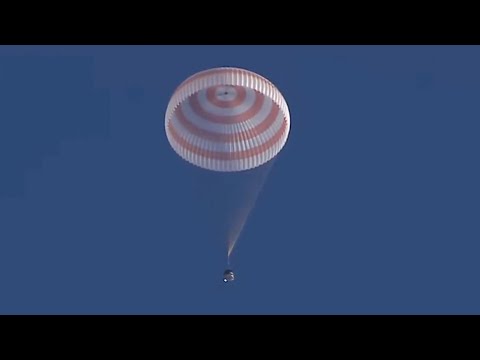
Pictured: the Soyuz MS-25 landing in Kazakhstan on September 23, 2024, which ended Oleg Kononenko’s record fifth mission, #1 with 1,111 days.
Rank
Name
Total time in space
Missions
Country
Agency
Status
1
Oleg Kononenko
1,111 d
5
Russia
Roscosmos
Active
2
Gennady Padalka
878 d 11 h 29 m
5
Russia
Roscosmos
Retired
3
Yuri Malenchenko
827 d 9 h 20 m
6
Russia
Roscosmos
Retired
4
Sergei Krikalev
803 d 9 h 39 m
6
Russia
Roscosmos
Retired
5
Aleksandr Kaleri
769 d
5
Russia
Roscosmos
Retired
6
Sergei Avdeyev
747 d
3
Russia
Roscosmos
Retired
7
Anton Shkaplerov
709 d 8 h 4 m
4
Russia
Roscosmos
Retired
8
Peggy Whitson
695 d
5
United States
NASA / Axiom Space
Active
9
Valeri Polyakov
678 d 16 h 33 m
2
Russia
Roscosmos
Retired
10
Fyodor Yurchikhin
672 d 20 h 38 m
5
Russia
Roscosmos
Retired
11
Anatoly Solovyev
651 d 2 h
5
Russia
Roscosmos
Retired
12
Sunita (Suni) Williams
608 d
3
United States
NASA
Retired
13
Aleksey Ovchinin
595 d
4
Russia
Roscosmos
Active
14
Don Pettit
590 d
4
United States
NASA
Active
15
Sergey Prokopyev
567 d 15 h 12 m
2
Russia
Roscosmos
Active
No matching rows.
As of October 7, 2026. Totals combine every mission to orbit; hours and minutes are shown where an agency or reference gave them, otherwise whole days. Russian entries include Soviet-era flights. Active flyers’ totals can still grow, so ranks below them can change: cosmonaut Pyotr Dubrov (355 days so far) is on the ISS on Soyuz MS-29 (launched July 14, 2026) and, if he completes the planned stay of roughly 261 days, would reach about 616 days and pass Suni Williams.[17] NASA’s Mike Fincke retired in 2026 with 549 days, just outside the list.[18] Status reflects press reports and may lag official rosters. Totals vary by a day or so between sources.[1]
The Top 10
#1
Oleg Kononenko — 1,111 days
On February 4, 2024, during his fifth spaceflight, Kononenko passed Gennady Padalka’s 878 days to become the person with the most cumulative time in space; when he landed aboard Soyuz MS-25 on September 23, 2024 he had about 1,111 days, the first person to pass 1,000.[2] He orbited Earth roughly 17,800 times and made seven spacewalks.[2] In March 2026 he was named head of the Gagarin Cosmonaut Training Center, and he remains listed as an active cosmonaut.[3] Some outlets round his total to 1,110 days.
#2
Gennady Padalka — 878 days
Padalka held the all-time record for cumulative time in space from 2015 until Kononenko passed him in 2024. He logged 878 days, 11 hours, 29 minutes over five flights, which span Mir and the ISS.[4] Some reports round the figure up to 879 days depending on the landing date they count.[4]
#3
Yuri Malenchenko — 827 days
Malenchenko made six flights across Mir, the Space Shuttle and the ISS, totaling 827 days, 9 hours, 20 minutes.[5] His last flight, Soyuz TMA-19M, carried him to the station on December 15, 2015, with ESA’s Tim Peake and NASA’s Tim Kopra.[5] He has since left the cosmonaut team.[5]
#4
Sergei Krikalev — 803 days
Krikalev logged 803 days, 9 hours, 39 minutes across six flights, including two long stays on Mir, two Space Shuttle missions and two ISS expeditions, completing the total in 2005.[6] He is remembered for his 311-day Mir mission of 1991–92, during which the Soviet Union dissolved around him.[6]
#5
Aleksandr Kaleri — 769 days
Kaleri completed five flights, including three long-duration missions on Mir, and reached 769 days in space.[1] His last flight was Expedition 25 on the ISS in 2010–11.[1]
#6
Sergei Avdeyev — 747 days
Avdeyev logged about 747.6 days across three tours on Mir, which made him the cumulative record holder until Krikalev passed him in August 2005.[7]
#7
Anton Shkaplerov — 709 days
Shkaplerov totals 709 days, 8 hours, 4 minutes over four flights; his latest was Soyuz MS-19 (Expedition 66), which landed on March 30, 2022 with NASA’s Mark Vande Hei and Pyotr Dubrov.[8]
#8
Peggy Whitson — 695 days
Whitson has 695 days over five missions, more than any other American or woman: three flights with NASA and two commanding Axiom Space missions.[9] Her fifth flight, Axiom-4, launched on June 25, 2025 and splashed down on July 15, 2025, adding 20 days to her earlier total of 675.[9] She is the highest-ranked person on this list who is not a cosmonaut.
#9
Valeri Polyakov — 678 days
Polyakov spent 678 days, 16 hours, 33 minutes in space over just two flights, which include the longest single spaceflight ever, 437 days aboard Mir from January 1994.[10] He died in December 2022 at age 80.[10]
#10
Fyodor Yurchikhin — 672 days
Yurchikhin logged 672 days, 20 hours, 38 minutes over five flights, including two ISS command tours (Expeditions 37 and 52), and retired on December 13, 2019.[11]
Statista, "Who has spent the most time in space?"; WION, "Who’s spent the most time in space? NASA’s top 7 astronauts" (June 2025); TBS News, "Who spent the most days in space?"; NASA, "Space Station Astronaut Record Holders."
Live Science, "Russian cosmonaut returns to Earth after completing record-breaking 1,111th day in space" (September 2024); Explorersweb, "Russian Cosmonaut Spends Record-Breaking 1,111 Days in Space"; Gulf News and VOA coverage of the record; YouTube, Soyuz MS-25 landing report.
Interfax and Ru-news reports (March 23, 2026) on Kononenko’s appointment to head the Gagarin Cosmonaut Training Center; Wikipedia, Oleg Kononenko.
National Geographic and Gizmodo, Padalka’s record coverage; Live Science (878 days, 11 hours, 29 minutes, 48 seconds); YouTube, NASA “Space Station Live: Padalka New Space Ironman.”
Spacefacts.de, Yuri Malenchenko biography; TASS, "Yuri Malenchenko leaves team of Russian cosmonauts"; YouTube, Tim Peake / Malenchenko / Kopra ISS arrival.
Wikipedia, Sergei Krikalev; New Mexico Museum of Space History inductee page; Living Legends of Aviation; YouTube, report on his return from Mir.
Wikipedia, Sergey Avdeev; asteroidday.org, Sergei Avdeyev profile.
Wikipedia and Spaceflight101, Anton Shkaplerov; Al Jazeera, "NASA Vande Hei, Russian Shkaplerov, Dubrov land on Earth" (March 30, 2022); YouTube, NASA Soyuz MS-19 undocking.
Space Policy Online, "Axiom-4 Back on Earth After 20 Days in Space"; Cybernews and GDN report on the Ax-4 return; Wikipedia, Peggy Whitson; YouTube, NASA 665-day record video.
Wikipedia and OrbitCodex, Valeri Polyakov; YouTube, report on his landing.
Wikipedia and Spaceflight101, Fyodor Yurchikhin; OrbitCodex profile; YouTube, NASA Expedition 37 landing.
Wikipedia, Anatoly Solovyev; Guinness World Records, "Most spacewalks by one person."
Space.com, "Record-setting astronaut Suni Williams retires from NASA after 27 years" (January 2026); IOL, Jalopnik and Deccan Herald coverage (608 days).
Wikipedia, Aleksey Ovchinin; Al Jazeera and News On AIR, Soyuz MS-26 return (April 20, 2025).
Space Policy Online and Ada Derana, Don Pettit’s April 2025 return (590 days); Wikipedia, Donald Pettit.
Wikipedia, Sergey Prokopyev (cosmonaut); Interfax and Spaceflight Now on his 2022–23 mission.
CGTN (July 15, 2026), Interfax (July 14, 2026) and RussianSpaceWeb on Soyuz MS-29; Wikipedia and Spacefacts.de, Pyotr Dubrov (355 d 3 h 46 m).
Space.com, "NASA astronaut Mike Fincke retires after 30 years at the space agency" (549 days).