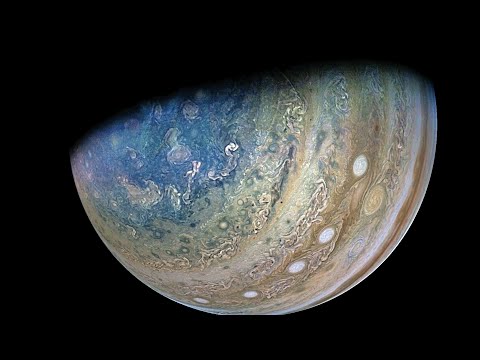
Jupiter’s Ganymede is the largest moon in the Solar System, about 5,262 km across and wider than Mercury. These are 15 moons ranked by mean diameter, from Ganymede down to Saturn’s Dione.
Pictured: a still from NASA’s “Juno Flies Past the Moon Ganymede and Jupiter”, showing Ganymede, #1 with a mean diameter of 5,262 km.
Rank
Moon
Parent body
Mean diameter (km)
Mass (10²¹ kg)
Orbital period (days)
Discovered
Notable feature
1
Ganymede
Jupiter
5,262.4
148.1
7.15
1610, Galileo Galilei
Largest moon; only moon with its own magnetic field
2
Titan
Saturn
5,149.5
134.5
15.95
1655, Christiaan Huygens
Dense nitrogen atmosphere and methane lakes
3
Callisto
Jupiter
4,820.6
107.6
16.69
1610, Galileo Galilei
Most heavily cratered surface known
4
Io
Jupiter
3,643.0
89.3
1.77
1610, Galileo Galilei
Most volcanically active body in the Solar System
5
Moon
Earth
3,474.8
73.5
27.32
Known since prehistory
Only moon humans have visited
6
Europa
Jupiter
3,121.6
48.0
3.55
1610, Galileo Galilei
Global ocean under an ice shell
7
Triton
Neptune
2,705.2
21.4
5.88 (retrograde)
1846, William Lassell
Orbits backwards; likely a captured Kuiper Belt object
8
Titania
Uranus
1,577.8
3.40
8.71
1787, William Herschel
Largest moon of Uranus
9
Rhea
Saturn
1,527.0
2.31
4.52
1672, Giovanni Cassini
Saturn's second-largest moon
10
Oberon
Uranus
1,522.8
3.08
13.46
1787, William Herschel
Outermost of Uranus's five major moons
11
Iapetus
Saturn
1,468.6
1.81
79.32
1671, Giovanni Cassini
One hemisphere dark, one bright; equatorial ridge
12
Charon
Pluto
1,212.0
1.59
6.39
1978, James Christy
Half Pluto's diameter; the two orbit a point between them
13
Umbriel
Uranus
1,169.4
1.27
4.14
1851, William Lassell
Darkest of the large Uranian moons
14
Ariel
Uranus
1,157.8
1.25
2.52
1851, William Lassell
Brightest of the Uranian moons, with canyons
15
Dione
Saturn
1,122.8
1.09
2.74
1684, Giovanni Cassini
Icy moon with bright cliffs
No matching rows.
Read this first: moons are ranked by mean diameter in kilometres, as of 25 October 2026. Each diameter is twice the mean radius in NASA/JPL’s Planetary Satellite Physical Parameters table (the radius of a sphere with the same volume as the moon), and each mass is the table’s GM divided by the gravitational constant, in units of 1021 kg.[1] That makes Ganymede 5,262.4 km; NASA’s Solar System Exploration page and Wikipedia round it to about 5,268–5,270 km, and Wikipedia gives Titan 5,149.5 km, Triton 2,706.8 km and Charon 1,212 km, all within a few kilometres of the JPL values. The order is the same on every source checked, but ranks 9 and 10 (Rhea 1,527.0 km, Oberon 1,522.8 km) are only about 4 km apart, and Umbriel and Ariel are about 12 km apart, so small revisions could swap them.[2][3] Orbital periods, discoverers and years come from Wikipedia’s articles on each moon and NASA’s moon pages; Triton orbits backwards (retrograde). Earth’s Moon counts as a moon, as the fifth-largest, and two moons, Ganymede and Titan, are larger than the planet Mercury (about 4,879 km), though Mercury has more mass. The table stops at Dione, the fifteenth-largest; Tethys (about 1,062 km) is next. Moons of dwarf planets other than Pluto’s Charon, such as Eris’s Dysnomia, are far smaller and left out. Counts of moons keep growing as new small ones are found, but none of those could change this table. The planets themselves are ranked in The Largest Planets in the Solar System.
The Top 10
#1
Ganymede — 5,262 km
Jupiter’s Ganymede is the largest moon in the Solar System. JPL’s radius of 2,631.2 km gives a diameter of 5,262 km; NASA’s Solar System Exploration page rounds it to about 5,268 km. Either way it is wider than Mercury (about 4,879 km), though only about 45% of Mercury’s mass because it is mostly ice and rock. It is the only moon known to generate its own magnetic field, and Galileo and Juno data point to a salty ocean under its crust. Galileo Galilei discovered it in January 1610. Juno passed 1,038 km above it on 7 June 2021, and ESA’s Juice will become the first spacecraft to orbit it. The video is NASA’s Juno flyby animation.[1][2][3]
#2
Titan — 5,150 km
Saturn’s Titan is the second-largest moon, about 6% wider than Mercury, and the only moon with a thick atmosphere, mostly nitrogen at a surface pressure about 1.5 times Earth’s. Methane and ethane fall as rain and fill lakes and seas near its poles. Huygens discovered it in 1655, and ESA’s Huygens probe landed on it in January 2005, the farthest landing from Earth so far. NASA’s Dragonfly rotorcraft is planned to fly there in the 2030s. The video is NASA’s overview of Titan.[1][2][3]
#3
Callisto — 4,821 km
Jupiter’s outermost large moon is the third-largest moon, just under Mercury’s width, and has one of the oldest, most heavily cratered surfaces known. Its Valhalla basin is a multi-ring impact structure about 3,800 km across. Galileo data suggest a possible subsurface ocean, though Callisto is much less geologically active than its neighbours. It lies outside most of Jupiter’s radiation, one reason it has been floated as a site for a future crewed base. No suitable video from an authoritative channel was verified, so the planet icon stands in.[1][2]
#4
Io — 3,643 km
The innermost of Jupiter’s large moons is the most volcanically active body known, with hundreds of volcanoes powered by tidal heating as Jupiter and its neighbours squeeze it. Lava lakes and plumes rise hundreds of kilometres. Voyager 1 spotted the first plume in 1979, and Juno flew within about 1,500 km in December 2023 and February 2024. At 3,643 km it is a little larger than the Moon. The video is NASA’s JunoCam flyby of Io.[1][2]
#5
The Moon — 3,475 km
Earth’s Moon counts here as a moon like any other, and it is the fifth-largest. It is about 27% of Earth’s diameter, a bigger share than any moon of the giant planets, though Pluto’s Charon is relatively larger still. It is the only moon visited by humans: twelve astronauts walked on it between 1969 and 1972. It orbits in 27.3 days and is tidally locked, so we always see the same side. The video is NASA Goddard’s tour of the Moon built from Lunar Reconnaissance Orbiter data.[1][2]
#6
Europa — 3,122 km
Slightly smaller than the Moon, Europa has a young, cracked ice shell over what is almost certainly a global saltwater ocean holding about twice the water of Earth’s oceans, according to NASA. That makes it a top target in the search for life. NASA’s Europa Clipper launched on 14 October 2024 and is due to reach Jupiter in 2030; ESA’s Juice will also fly past it. The video is JPL’s overview of the Clipper mission.[1][2][3]
#7
Triton — 2,705 km
Neptune’s largest moon orbits backwards (retrograde), the sign of a body captured from the Kuiper Belt, where it was probably a dwarf planet like Pluto. Voyager 2, the only spacecraft to visit, saw nitrogen geysers and a surface at about −235 °C in August 1989. William Lassell found it in October 1846, 17 days after Neptune itself. It is slowly spiralling inward. No suitable video from an authoritative channel was verified, so the planet icon stands in.[1][2]
#8
Titania — 1,578 km
The largest moon of Uranus is less than half the width of Triton and less than a third of Ganymede’s. William Herschel found it, and Oberon, on 11 January 1787. Voyager 2 flew past in 1986 and saw canyons up to about 1,500 km long and scarps. It is named for the fairy queen in Shakespeare’s A Midsummer Night’s Dream. No suitable video from an authoritative channel was verified, so the planet icon stands in.[1][2]
#9
Rhea — 1,527 km
Saturn’s second-largest moon is a heavily cratered ball of ice and rock, found by Giovanni Cassini in December 1672. At 1,527 km it is only about 4 km wider than Uranus’s Oberon by JPL’s radii, so ranks 9 and 10 are close. Cassini data in 2010 hinted at a faint ring system, which later work did not confirm. No suitable video from an authoritative channel was verified, so the planet icon stands in.[1][2]
#10
Oberon — 1,523 km
The outermost of Uranus’s five major moons is about the size of Rhea, only about 4 km narrower by JPL’s radii (Wikipedia gives 1,522.8 km too), so their order is close. Herschel found it in 1787, and Voyager 2’s 1986 flyby imaged cratered terrain with dark crater floors and a mountain about 11 km high. No suitable video from an authoritative channel was verified, so the planet icon stands in.[1][2]
NASA Solar System Exploration moon pages, Ganymede, Titan, Io, Europa and Earth’s Moon. The pages were not all opened; figures were cross-checked against the JPL table and Wikipedia.
Videos: NASA, NASA Goddard and NASA Jet Propulsion Laboratory on YouTube; each ID was checked for channel and title. Callisto, Triton, Titania, Rhea and Oberon have no video here because none from an authoritative channel was verified.