Proxima Centauri is the closest star to the Sun, 4.25 light-years away, followed by the two bright stars of Alpha Centauri and Barnard’s Star. This ranking lists every individual star and brown dwarf within 11 light-years (one row per object, so a double star takes two rows and tied distances share a rank), unlike our rankings of the planets, moons and telescopes in the same space. Distances are from Gaia-based parallaxes, as of November 2026.
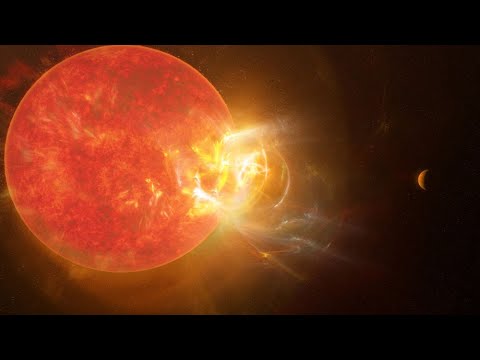
Pictured: Proxima Centauri, #1 at 4.2465 light-years, in an EarthSky explainer video.
Distances as of November 2026, from the parallaxes in Wikipedia’s “List of nearest stars and brown dwarfs” (mostly Gaia-based, Brown 2021); spectral types from the RECONS list. Each of these will shift slightly with every new data release. One row per star or brown dwarf; members of one system share its distance and rank. Apparent magnitude is visual (V) unless marked J band for the cool brown dwarfs, where V is not meaningful; Luhman 16 B has no separate magnitude in the source (shown as —). The naked eye limit is about magnitude 6 under dark skies. Confirmed planets are the NASA Exoplanet Archive’s count (queried November 2026); candidates such as Proxima c and Alpha Centauri Ab are not counted. Objects farther than 11.01 light-years (including 61 Cygni and Procyon) are left out.[1][2][3]
The Top 10
#1
Proxima Centauri — 4.25 light-years
Proxima is the closest star to the Sun, 4.2465 light-years away, but it is a faint red dwarf of magnitude 11.09 and cannot be seen without a telescope.[1][2] The NASA Exoplanet Archive lists two confirmed planets, Proxima b and Proxima d; a third, Proxima c, is still a candidate.[3] It is the third member of the Alpha Centauri system. The video is EarthSky’s short explainer.
#2 (tie)
Alpha Centauri A (Rigil Kentaurus) — 4.34 light-years
A Sun-like G2V star and the brightest of the nearest stars at magnitude 0.01, it shares a distance of 4.3441 light-years with its companion B.[1] A 2025 James Webb Space Telescope image showed a faint point of light that is a candidate giant planet; it has not been confirmed, and the NASA Exoplanet Archive lists no confirmed planets for it.[3][4] The video is a news report on that candidate.
#2 (tie)
Alpha Centauri B (Toliman) — 4.34 light-years
A K1V orange star slightly cooler than the Sun, magnitude 1.34, orbiting A.[1] To the naked eye A and B blend into one bright point, the third-brightest star in the sky when counted together; no confirmed planets are listed for it.[3]
#4
Barnard’s Star — 5.96 light-years
The nearest single star to the Sun, at 5.9629 light-years, is a magnitude-9.53 red dwarf in Ophiuchus.[1] The NASA Exoplanet Archive lists four confirmed planets, all smaller than Earth and all orbiting in about a week or less; the first was announced by ESO in 2024 and the other three in 2025.[3][5] The video covers the four-planet result.
#5 (tie)
Luhman 16 A — 6.51 light-years
Luhman 16 is a pair of brown dwarfs found in 2013, the nearest new neighbours discovered in almost a century and the closest brown dwarfs to the Sun.[1][6] A is an L-type brown dwarf about 6.51 light-years away; brown dwarfs are too small to fuse hydrogen like stars, and this one is far too faint to see without a telescope. The video is an explainer on the pair.
#5 (tie)
Luhman 16 B — 6.51 light-years
The T-type partner of A, cooler and more variable in brightness; Hubble observations found changing cloud patterns that make it the better-studied of the two.[6] The NASA Exoplanet Archive has an entry for Luhman 16 b, but it is this brown dwarf companion rather than a planet, so no planets are counted here.[3]
#7
WISE 0855−0714 — 7.43 light-years
The coldest known isolated object of its kind, at about 275 K (roughly 2 °C), a Y-type brown dwarf of an estimated 3 to 10 Jupiter masses, sometimes called a planetary-mass object.[7] It is the only entry in the table that orbits no known star, and JWST has measured water, ammonia and phosphine in its atmosphere.[7]
#8
Wolf 359 — 7.86 light-years
A tiny, dim M6 red dwarf in Leo, magnitude 13.44, at 7.856 light-years.[1] It is better known from fiction: the Battle of Wolf 359 in Star Trek: The Next Generation. No planet is confirmed in the NASA Exoplanet Archive.[3]
#9
Lalande 21185 — 8.30 light-years
A red dwarf in Ursa Major at magnitude 7.47, too dim for the naked eye.[1] The NASA Exoplanet Archive lists two confirmed planets (GJ 411 b and c).[3]
#10 (tie)
Sirius A — 8.71 light-years
Sirius A is the brightest star in the night sky (magnitude −1.46), an A1 main-sequence star of about 2.15 solar masses.[1][8] Its companion Sirius B, tied at the same distance, is a white dwarf of about 1.05 solar masses, first seen in 1862, and the only white dwarf in the table.[8] The video is an observer’s account of spotting Sirius B.
Wikipedia, “List of nearest stars and brown dwarfs” (distances, spectral types, magnitudes; cites Brown 2021 Gaia parallaxes and the RECONS list).
RECONS (Research Consortium on Nearby Stars), “The 100 Nearest Star Systems”; YouTube, EarthSky, “Proxima Centauri, Closest Star to our Sun”.
NASA Exoplanet Archive, Planetary Systems Composite Parameters table (confirmed planet counts per host star, queried November 2026).
YouTube, KHOU 11, “NASA’s James Webb telescope spots possible giant planet near Alpha Centauri” (2025 JWST candidate).
ESO, “New planet discovered orbiting closest single star to our Sun” (eso2414, October 2024); YouTube, Science X, “Four planets orbit Barnard’s Star, too hot for life”.
YouTube, Learning Curve, “Luhman 16 - The closest Brown Dwarfs to Earth”; arXiv 1708.02714 and 1509.06148 (Luhman 16 AB masses and variability).
arXiv 2410.10933 and 2311.17316 (JWST observations of WISE 0855−0714, the coldest known brown dwarf).
arXiv 1703.10625, “The Sirius System and its Astrophysical Puzzles” (masses, discovery of Sirius B in 1862); YouTube, AstronomyLive, “Observing Sirius-B, the white dwarf ‘Pup’”.