Among spacecraft with published JPL Horizons trajectories, Voyager 1 is the farthest from Earth: 25.88 billion km (173 AU) on November 9, 2026 at 12:00 UT, ahead of Voyager 2 (21.66 billion km) and Pioneer 10 (21.15). The probes move away every day, so the figures are a snapshot, but the top five stay in this order. This ranks spacecraft by distance from Earth, not from the Sun; for the Sun’s nearest stars see The Closest Stars to the Sun, and for the planets The Largest Planets.
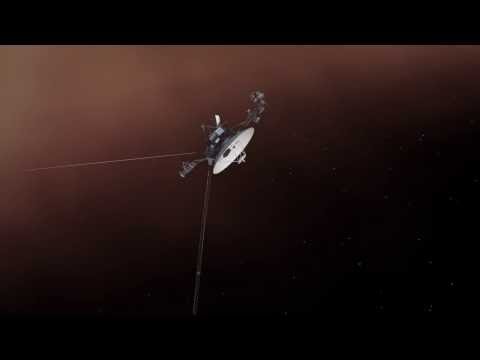
Pictured: Voyager 1, #1 at 25.88 billion km, in the thumbnail of NASA JPL’s video on its crossing into interstellar space.
Rank
Spacecraft
Distance from Earth (billion km)
Distance (billion miles)
Distance (AU)
One-way light time (hours)
Launched
Agency
Status
Mission
1
Voyager 1
25.881
16.082
173.005
23.98
1977
NASA
Active
Interstellar space probe
2
Voyager 2
21.658
13.457
144.772
20.07
1977
NASA
Active
Interstellar space probe
3
Pioneer 10
21.149
13.142
141.375
19.60
1972
NASA
Contact lost
First probe to Jupiter
4
Pioneer 11
17.760
11.035
118.717
16.46
1973
NASA
Contact lost
Jupiter and Saturn flyby
5
New Horizons
9.947
6.181
66.495
9.22
2006
NASA
Active
Pluto and Kuiper Belt flyby
6
Lucy
0.925
0.575
6.183
0.86
2021
NASA
Active
Jupiter Trojan asteroids
7
Juno
0.802
0.498
5.359
0.74
2011
NASA
Active
Jupiter orbiter
8
Dawn
0.312
0.194
2.086
0.29
2007
NASA
Mission ended
Vesta and Ceres orbiter
9
Spitzer Space Telescope
0.299
0.186
1.997
0.28
2003
NASA
Mission ended
Infrared space telescope
10
Ulysses
0.282
0.175
1.885
0.26
1990
ESA/NASA
Mission ended
Solar polar orbiter
No matching rows.
Distance from Earth’s center on November 9, 2026, 12:00 UT. Every figure is the range from NASA/JPL’s Horizons system (geometric position of each spacecraft relative to Earth, queried for that one moment), converted from astronomical units (1 AU = 149,597,870.7 km) to km and miles.[1] Distances change daily: Voyager 1 adds about 1.5 million km a day. For Pioneer 10 and 11, Ulysses and Dawn, which no longer transmit, Horizons gives a trajectory computed from their last tracking, not a live measurement. Status is as of November 2026. Rules: only spacecraft with a published Horizons trajectory covering that moment count, one row per mission; we checked every Horizons spacecraft ID from -1 to -3000. Missions without a Horizons trajectory, such as China’s Tianwen probes, are not covered, so this is a ranking among Horizons spacecraft rather than of every object ever launched. Next after the table come Kepler (1.79 AU, retired), two spent rocket stages, Psyche (1.67 AU) and the spacecraft in Mars orbit (about 1.36 AU).
The Top 10
#1
Voyager 1 — 25.88 billion km
Voyager 1 is the most distant spacecraft, and on November 9, 2026 its radio signal needed 23.98 hours to reach Earth. NASA expects it to reach one light-day from Earth on November 18, 2026.[1][2][3] Launched on September 5, 1977, it became the first spacecraft to exit the heliosphere in August 2012. The video covers that crossing.
#2
Voyager 2 — 21.66 billion km
Voyager 2, launched on August 20, 1977, is 20.07 light-hours away, about 4.2 billion km behind Voyager 1. It flew past all four giant planets: Jupiter (1979), Saturn (1981), Uranus (1986) and Neptune (1989).[1][3] NASA dates its entry into interstellar space to November 2018. The video is JPL’s report on that crossing.
#3
Pioneer 10 — 21.15 billion km
Pioneer 10, launched in March 1972, completed the first mission to Jupiter, with its closest approach in December 1973. NASA received its last signal on January 23, 2003, so the distance here is a trajectory computed by JPL, not a measurement.[1][4] No verified official video was available, so an icon is shown.
#4
Pioneer 11 — 17.76 billion km
Pioneer 11, launched in April 1973, flew past Jupiter in December 1974 and Saturn in September 1979. Its final signal was received on November 24, 1995, so JPL’s trajectory places it 17.76 billion km away.[1][5] No verified official video was available, so an icon is shown.
#5
New Horizons — 9.95 billion km
New Horizons, launched on January 19, 2006, flew past Pluto on July 14, 2015 and the Kuiper Belt object Arrokoth on January 1, 2019.[1][6] At 9.22 light-hours it is the only other active spacecraft in this table beyond 10 AU. The video shows its best view of Pluto’s surface.
#6
Lucy — 0.93 billion km
Lucy, launched on October 16, 2021, is the first mission to the Jupiter Trojan asteroids, and at 6.18 AU the drop from New Horizons is the biggest gap in the table. Its next flyby is Eurybates on August 11, 2027.[1][7] The video is NASA’s mission overview.
#7
Juno — 0.80 billion km
Juno launched on August 5, 2011 and has orbited Jupiter since July 4, 2016. At 5.36 AU it is about as far from Earth as Jupiter is. NASA’s page still said the mission was scheduled to end in September 2025, but the spacecraft was operating in 2026, with its funding undecided.[1][8][9] The video is JPL’s time-lapse of its approach to Jupiter.
#8
Dawn — 0.31 billion km
Dawn, launched on September 27, 2007, stayed at both Vesta and Ceres. NASA announced on November 1, 2018 that it had run out of hydrazine and the mission was over, and the dead spacecraft remains in an uncontrolled orbit around Ceres, so JPL’s trajectory gives its position.[1][10][11] The video is NASA’s mission film.
#9
Spitzer Space Telescope — 0.30 billion km
Spitzer, launched on August 25, 2003, was decommissioned on January 30, 2020. It orbits the Sun trailing Earth, so it drifts steadily away from us; at 1.997 AU it just edges out Ulysses.[1][12] The video is JPL’s salute to the mission’s end.
#10
Ulysses — 0.28 billion km
Ulysses, launched on October 6, 1990, was the first mission to study space above and below the Sun’s poles. Its mission ended on June 30, 2009, but its 6.2-year orbit, which ranges from 1.4 to 5.4 AU from the Sun, keeps it 1.89 AU from Earth on this date.[1][13] The video is ESA’s retrospective.
NASA/JPL Solar System Dynamics, Horizons System API: vectors from Earth’s center (500@399), UT 2026-11-09 12:00, for targets -31, -32, -23, -24, -98, -49, -61, -203, -79, -55 (queried November 9, 2026) — ssd.jpl.nasa.gov/horizons.
NASA/JPL, Voyager mission status and the one-light-day milestone, reported by ScienceDaily (November 2026) — sciencedaily.com.