The Largest Asteroids and Dwarf Planets in the Solar System
Pluto is the widest dwarf planet at about 2,377 km, just ahead of Eris (2,326 km), while Ceres, at 939 km, is the largest object in the asteroid belt. This ranks small bodies by mean diameter: the five IAU dwarf planets, the large trans-Neptunian candidates and the biggest main-belt asteroids. For the eight planets see The Largest Planets in the Solar System, and for natural satellites The Largest Moons in the Solar System.
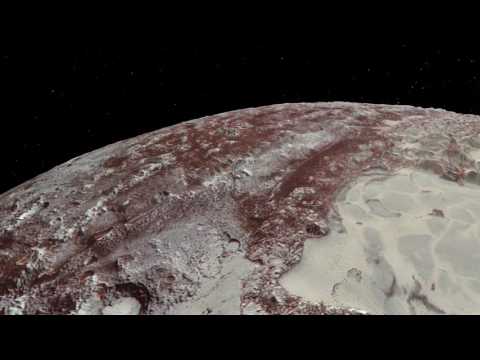
Pictured: Pluto, #1 with a mean diameter of about 2,377 km, from a flyover built from New Horizons data.
Rank
Body
Mean diameter (km)
Mean diameter (mi)
Type
Orbit region
Mass (×1018 kg)
Discovered
Discoverer
Spacecraft visit
1
Pluto
2,377
1,477
Dwarf planet
Kuiper belt
13,030
1930
Clyde Tombaugh
Yes: New Horizons (2015)
2
Eris
2,326
1,445
Dwarf planet
Scattered disc
16,380
2003
Brown, Trujillo, Rabinowitz
No
3
Haumea
1,544
959
Dwarf planet
Kuiper belt
3,952
2003
Ortiz et al. (Sierra Nevada); Brown team (Palomar) disputed
No
4
Makemake
1,430
889
Dwarf planet
Kuiper belt
2,690
2005
Brown, Trujillo, Rabinowitz
No
5
Gonggong
1,230
764
Candidate dwarf planet
Scattered disc
1,750
2007
Schwamb, Brown, Rabinowitz
No
6
Quaoar
1,098
682
Candidate dwarf planet
Kuiper belt
1,212
2002
Trujillo, Brown
No
7
Ceres
939.4
584
Dwarf planet
Main belt
938
1801
Giuseppe Piazzi
Yes: Dawn (2015–2018)
8
Orcus
910
565
Candidate dwarf planet
Kuiper belt
548
2004
Brown, Trujillo, Rabinowitz
No
9
Salacia
838
521
Trans-Neptunian object
Kuiper belt
486
2004
Roe, Brown, Barkume
No
10
Varda
740
460
Trans-Neptunian object
Kuiper belt
244
2003
J. A. Larsen
No
11
Ixion
697
433
Trans-Neptunian object
Kuiper belt
—
2001
Deep Ecliptic Survey
No
12
Vesta
522.8
325
Main-belt asteroid
Main belt
259
1807
Heinrich Olbers
Yes: Dawn (2011–2012)
13
Pallas
513
319
Main-belt asteroid
Main belt
204
1802
Heinrich Olbers
No
14
Hygiea
432
268
Main-belt asteroid
Main belt
87
1849
Annibale de Gasparis
No
15
Interamnia
332
206
Main-belt asteroid
Main belt
35
1910
Vincenzo Cerulli
No
No matching rows.
Diameters are mean diameters as of November 2026. Asteroid and Ceres values come from NASA/JPL’s Small-Body Database (Ceres from Dawn, Vesta from Park et al. 2025, Pallas from Marsset et al. 2020); Hygiea (432 km, VLT/SPHERE imaging) and Interamnia (332 km) use the compiled values in Wikipedia’s list of Solar System objects by size, because the database still shows older infrared estimates for them (407 and 306 km). Pluto is from New Horizons, and Eris, Haumea, Makemake, Quaoar, Varda and Ixion are occultation-based; Gonggong, Orcus and Salacia are thermal estimates with wider error bars. NASA and the database do not publish diameters for the distant objects, so those come from the compiled list of possible dwarf planets.[1][2][3] Haumea is an ellipsoid, so its figure is a mean (volume-equivalent) diameter. The IAU recognizes only Ceres, Pluto, Haumea, Makemake and Eris as dwarf planets; the other TNOs are labelled “candidate” or “trans-Neptunian object” as the sources do. Sedna (about 900 km, with an uncertainty of several hundred) is left out because its size is too uncertain to rank, and Europa (320 km) and Davida (298 km) fall below the cut. Mass is shown to the precision published, and Ixion has no published mass.
The Top 10
#1
Pluto — 2,377 km
About 2,377 km across, Pluto is the largest dwarf planet by diameter, measured directly by New Horizons when it flew past on July 14, 2015.[2][3] It is a plutino in the Kuiper belt, locked in a 2:3 orbital resonance with Neptune. Eris is slightly heavier, but Pluto is wider. The video is a flyover built from New Horizons data.
#2
Eris — 2,326 km
Eris is only about 50 km narrower than Pluto, but it holds more mass, roughly 16,380 × 1018 kg against Pluto’s 13,030.[3] Its size comes from a stellar occultation, not a flyby. It travels a scattered-disc orbit well beyond the Kuiper belt, and its 2005 announcement helped push the IAU to define “dwarf planet” in 2006.[2] No suitable official video was verified, so an icon is shown.
#3
Haumea — 1,544 km
Haumea spins about once every four hours, which stretches it into an egg-shaped ellipsoid, so no single diameter describes it.[3] The 1,544 km here is a mean (volume-equivalent) figure; NASA quotes an equatorial diameter of about 1,740 km.[2] Credit for its discovery is disputed between a Spanish team (2003 data) and Mike Brown’s team in California. The video is a NOVA explainer on its shape.
#4
Makemake — 1,430 km
Makemake is about 1,430 km wide, close to the size NASA gives (888 miles).[2][3] Found at Palomar in 2005, it is one of the brightest objects in the Kuiper belt and has one known moon. The video covers Hubble’s discovery of that moon.
#5
Gonggong — 1,230 km
Gonggong’s 1,230 km (±50) comes from thermal measurements, so it is less certain than the occultation-based sizes above it.[3] The IAU has not listed it, though many planetary scientists treat it as a dwarf planet; it sits on a scattered-disc orbit and has a moon, Xiangliu.[1] No verified official video, so an icon is shown.
#6
Quaoar — 1,098 km
Quaoar is about 1,098 km across, measured by stellar occultations.[3] It has a ring system far outside the distance where rings were expected to survive, which astronomers announced in 2023. Quaoar is a candidate dwarf planet here, although an IAU annual report has labelled it one. No verified official video, so an icon is shown.
#7
Ceres — 939.4 km
Ceres is the only dwarf planet in the inner solar system and, at 939.4 km, the largest object in the asteroid belt.[1] NASA’s Dawn orbited it from 2015 to 2018 and measured its shape as 964.4 × 964.2 × 891.8 km.[1] Ceres holds about a third of the belt’s mass. The video is a JPL flyover made from Dawn images.
#8
Orcus — 910 km
Orcus is a plutino, sharing Pluto’s 2:3 resonance with Neptune, and is nicknamed the “anti-Pluto” because its orbit mirrors Pluto’s.[3] Its 910 km diameter is a thermal estimate (range about 870 to 960 km), and the IAU has not accepted it. No verified official video, so an icon is shown.
#9
Salacia — 838 km
Salacia is a classical Kuiper belt object of about 838 km (±44) with a moon, Actaea, which allows its mass to be weighed.[3] It is a trans-Neptunian object that may or may not be round enough to count as a dwarf planet. No verified official video, so an icon is shown.
#10
Varda — 740 km
Varda’s 740 km (±14) comes from stellar occultations, and it has a moon, Ilmar, nearly half its size.[3] Discovered at Kitt Peak in 2003, it is another Kuiper belt body whose status is unsettled. No verified official video, so an icon is shown.