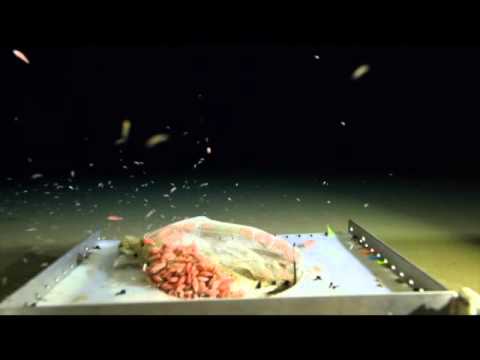
The Mariana Trench’s Challenger Deep, about 10,935 m below sea level, is the deepest known point in the ocean. These are 14 ocean trenches ranked by the maximum known depth of their deepest point.
Pictured: a still from Schmidt Ocean Institute’s “Challenger Deep video”, lander footage from the Mariana Trench’s Challenger Deep, #1 with a depth of 10,935 ± 6 m.
Rank
Trench
Deepest point
Max depth (m)
Ocean
Length (km)
Plate boundary
Crewed visit
Notes
1
Mariana Trench
Challenger Deep
10,935 ± 6
Pacific
2,550
Pacific plate subducts under the Mariana plate
Yes: Trieste, 1960; Five Deeps, 2019
Deepest known point in the ocean
2
Tonga Trench
Horizon Deep
10,823 ± 10
Pacific
—
Pacific plate subducts westward
Yes: Five Deeps, June 2019
Deepest point in the Southern Hemisphere
3
Philippine Trench
Emden Deep (Galathea Depth)
~10,540
Pacific
~1,320
Convergent (subduction) boundary
Yes: 2021
Third deepest known
4
Kermadec Trench
Scholl Deep
~10,047
Pacific
~1,000
Pacific plate subducts under the Indo-Australian plate
Yes: 2022 (Fendouzhe)
Only Wikipedia gives 10,047 m; NIWA says about 10 km
5
Izu–Ogasawara (Izu–Bonin) Trench
Unnamed
9,826 ± 11
Pacific
—
Pacific plate subducts under the Philippine Sea plate
Yes: Aug 2022
Nagoya University reports 9,801 m for the dive
6
Kuril–Kamchatka Trench
Unnamed
~9,604
Pacific
~2,900
Pacific plate subducts under the Okhotsk plate
None found
Britannica still gives 10,542 m, which surveys do not support
7
Yap Trench
Unnamed
8,929 ± 9
Pacific
~650
Caroline plate subducts beneath the Philippine Sea plate
Yes: 2022
Older sources give 8,527 m
8
Puerto Rico Trench
Milwaukee Deep
8,376
Atlantic
~810
North American plate subducts obliquely under the Caribbean plate
Yes: Dec 2018
Deepest point in the Atlantic Ocean
9
South Sandwich Trench
Meteor Deep
8,266 ± 11
Atlantic
~965
South American plate subducts under the South Sandwich plate
Yes: Feb 2019
Its southern end is the deepest point of the Southern Ocean (Factorian Deep, ~7,434 m)
10
Peru–Chile (Atacama) Trench
Richards Deep
~8,065
Pacific
~5,900
Nazca plate subducts under the South American plate
Yes: 2022
Longest trench in the table
11
Japan Trench
Unnamed
~8,046
Pacific
~800
Pacific plate subducts under the Okhotsk plate
Yes: Aug 2022
Dive reached 8,001 ± 9 m
12
Aleutian Trench
Unnamed
~7,822
Pacific
~3,400
Pacific plate subducts under the North American plate
None found
Runs along the Aleutian Islands
13
Sunda (Java) Trench
Java Deep
~7,290
Indian
~3,200
Indo-Australian plate subducts under the Eurasian (Sunda) plate
Yes: Apr 2019
Deepest point in the Indian Ocean; measured 7,192 ± 13 m at the dive site
14
Middle America Trench
Unnamed
~6,669
Pacific
~2,750
Cocos and other plates subduct under the North American and Caribbean plates
None found
Off Mexico to Costa Rica
No matching rows.
Read this first: trenches are ranked by the maximum known depth of their deepest point, in metres below sea level. These are best estimates from sonar (multibeam echo sounders) and, where a crewed submersible reached the bottom, pressure sensors, and they vary by method, so the table gives ± error only where a source states one and “~” where it gives a single rounded figure. Depths come from Wikipedia’s List of oceanic trenches and each trench’s own article, checked against primary sources where they exist: the 2019–2022 Five Deeps and Ring of Fire expeditions of Caladan Oceanic and Victor Vescovo (Tonga, Yap, South Sandwich and Puerto Rico), NOAA’s Ocean Service for Challenger Deep, and the NIWA and Chinese Academy of Sciences reports for Kermadec.[1][2][3][5] Where two figures disagree, the one from a modern survey is used and the other is named: Challenger Deep is 10,935 ± 6 m in the University of New Hampshire survey NOAA cites, and 10,925 ± 4 m on Vescovo’s 2019 dive; Wikipedia’s Tonga article says 10,800 ± 10 m but the Five Deeps survey gave 10,823 ± 10 m; Britannica gives the Kuril–Kamchatka Trench 10,542 m, but the SO250 survey measured its deepest point at about 9,604 m, so the lower figure is used; Britannica’s 8,527 m for the Yap Trench is older than the 8,929 ± 9 m measured in 2022.[4] The Kermadec figure of 10,047 m appears only in Wikipedia’s list; NIWA and the Chinese Academy of Sciences say “nearly 10 km”, so it carries less weight than the rest. Japan Trench depths range from 8,001 m (the 2022 dive) to Wikipedia’s 8,046 m; the Peru–Chile Trench’s named Richards Deep is 8,065 m, while a 2022 dive found 8,069 ± 8 m at an unnamed deep about 77 nautical miles to the north. Because of these differences, trenches within a few tens of metres of each other (Peru–Chile and Japan, 8,065 and 8,046 m) could swap places. The Philippine Trench’s 10,540 m dates from the 1951 Galathea expedition and is not a modern sonar figure. Lengths are as stated in each trench’s article and measured along the trench axis, so they are approximate; the Kermadec figure covers the Kermadec Trench alone, not the combined Tonga–Kermadec system, and the Izu–Ogasawara and Tonga lengths are left blank because no length was sourced. “Crewed visit” means a crewed submersible reached the trench’s deepest area or the bottom; “none found” means none turned up in the sources read, not that none has happened. The table leaves out trenches whose depths have only a single source (New Britain, 9,140 m) and troughs that are not subduction trenches (Cayman Trough, 7,686 m). Deep lakes are ranked in The Deepest Lakes in the World.
The Top 10
#1
Mariana Trench — 10,935 m
The Mariana Trench in the western Pacific is a crescent about 2,550 km long and 69 km wide, and its southern end, Challenger Deep, is the deepest known point in the ocean: 10,935 ± 6 m by the University of New Hampshire survey that NOAA cites. Vescovo’s 2019 dive measured 10,925 ± 4 m. The Pacific plate sinks under the smaller Mariana plate here. The bathyscaphe Trieste made the first crewed descent in 1960, and Wikipedia counts 22 crewed descents as of 2022. The video is Schmidt Ocean Institute’s footage of its lander at Challenger Deep.[1][2][3]
#2
Tonga Trench — 10,823 m
The Tonga Trench’s Horizon Deep, named for the research ship Horizon, is the deepest point in the Southern Hemisphere and second on Earth. The Five Deeps survey measured 10,823 ± 10 m, about 100 m short of Challenger Deep (Wikipedia’s article gives 10,800 ± 10 m). The Pacific plate is subducting westward here at what Wikipedia calls the fastest plate velocity on Earth. Vescovo made the first crewed descent on 10 June 2019. The video is Caladan Oceanic’s sonar fly-through of the trench.[1][2]
#3
Philippine Trench — ~10,540 m
East of the Philippines, the trench is about 1,320 km long and 30 km wide, and its deepest point, the Emden Deep (also called the Galathea Depth), reaches about 10,540 m. The German cruiser Emden found the depth in 1927 and Denmark’s Galathea expedition explored it in 1951. The 1944 Battle off Samar was fought over the trench, and some of the deepest known shipwrecks lie there. Vescovo and Filipino oceanographer Deo Florence Onda made the first crewed descent in 2021. The video is Caladan Oceanic’s account of that dive.[1][2][4]
#4
Kermadec Trench — ~10,047 m
North-east of New Zealand, the Kermadec Trench runs about 1,000 km from the Louisville Seamount Chain to the Hikurangi Plateau as the southern half of the Tonga–Kermadec subduction system. Wikipedia gives its depth as 10,047 m; NIWA and the Chinese Academy of Sciences say its Scholl Deep is nearly 10 km down. In December 2022 a joint Chinese Academy of Sciences and NIWA team dived there in the crewed submersible Fendouzhe, described as only the second crewed visit to the Scholl Deep. The clip is a news report on that dive, by New China TV, not an institution’s own channel.[1][5]
#5
Izu–Ogasawara Trench — 9,826 m
South of Japan, the Pacific plate sinks under the Philippine Sea plate along this trench, also called the Izu–Bonin Trench. Wikipedia gives 9,826 ± 11 m at its deepest point; Nagoya University reported 9,801 m for the dive. Vescovo and Professor Katsuyoshi Michibayashi of Nagoya University made the first crewed descent on 13 August 2022, a Japanese depth record that had stood since 1962. A snailfish filmed in the trench at 8,336 m that month is the deepest fish ever recorded on camera. The video is a general documentary on the Ring of Fire Expedition that made the dive, not a film of this trench alone.[1][6]
#6
Kuril–Kamchatka Trench — ~9,604 m
Running about 2,900 km along the Kuril Islands and Kamchatka, it is called the Chishima Trench in Japan; the Pacific plate sinks under the Okhotsk plate here. Britannica gives a maximum depth of 10,542 m, but peer-reviewed papers report about 9,600 m and the SO250 survey measured 9,604 m at its deepest point, so the lower figure is used. No crewed visit was found in the sources read. The video is Caladan Oceanic’s fly-through of the mapped trench.[1][4]
#7
Yap Trench — 8,929 m
A J-shaped trench of about 650 km near Yap Island, formed where the Caroline plate subducts under the Philippine Sea plate. Britannica and Wikipedia give 8,527 m, an older figure, but a 2022 crewed dive in the Ring of Fire Expedition recorded 8,929 ± 9 m, which is used here. It is the deepest trench outside the top six, ahead of the Atlantic’s Puerto Rico Trench. The video is Caladan Oceanic’s sonar fly-through.[1][2][4]
#8
Puerto Rico Trench — 8,376 m
The deepest point in the Atlantic Ocean, the Milwaukee Deep, lies in this 810 km trench north of Puerto Rico. Wikipedia and the Five Deeps expedition give 8,376 m, with other sources giving 8,378 m and about 8,380 m, and Wikipedia notes documented depths up to 8,740 m. Vescovo made the first crewed descent in December 2018 after the DSSV Pressure Drop found the exact point by sonar. The North American plate is subducting obliquely under the Caribbean plate here, and the trench has not ruptured in over 200 years. No suitable video from an authoritative channel was found, so the icon is shown instead.[1][2]
#9
South Sandwich Trench — 8,266 m
A 965 km trench east of the South Sandwich Islands, where the South American plate sinks under the small South Sandwich plate. The Five Deeps survey measured 8,266 m at the Meteor Deep, with an error of about 11–13 m, and found the trench 804 m deeper than the global GEBCO 2019 grid had it. Its southern end passes 60°S and holds the deepest point of the Southern Ocean, the proposed Factorian Deep at about 7,434 m, which Vescovo reached on 4 February 2019. The video is Caladan Oceanic’s sonar fly-through.[1][2]
#10
Peru–Chile (Atacama) Trench — ~8,065 m
The longest trench here, about 5,900 km along the coasts of Peru and Chile, where the Nazca plate subducts under the South American plate. Wikipedia and Britannica give 8,065 m at Richards Deep; a 2022 Caladan Oceanic dive led by Vescovo and Chilean oceanographer Osvaldo Ulloa recorded 8,069 ± 8 m at a different, unnamed deep to the north, which does not change the ranking. The video is Scripps Oceanography’s on its ATACAMEX lander, which reached about 25,000 ft (7,600 m) in the trench.[1][2]
Five Deeps Expedition and Caladan Oceanic (Victor Vescovo) releases: fivedeeps.com for the Tonga, Puerto Rico, South Sandwich and Challenger Deep dives (2018–2019); Atacama Trench press release; EYOS Expeditions and Caladan for the 2022 Ring of Fire dives (Yap, Izu–Ogasawara, Japan Trench). Figures as quoted in search results and Wikipedia; the pages were not all opened.
Britannica entries for the Kuril Trench (10,542 m), Yap Trench (8,527 m) and Philippine Trench, as quoted in search results; the Britannica pages themselves could not be opened from here, so these are second-hand.
Nagoya University: Katsuyoshi Michibayashi’s 2022 dive into the Izu–Ogasawara Trench (9,801 m).
Videos: Schmidt Ocean Institute, Caladan Oceanic, Scripps Oceanography and New China TV on YouTube; each ID was checked for channel and title, and the Izu–Ogasawara video is a general expedition documentary.