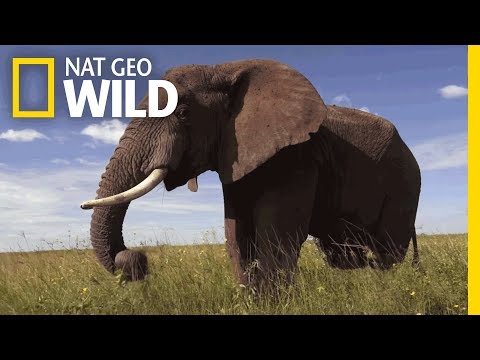
The African bush elephant is the heaviest living land animal, averaging about 6,000 kg for an adult male, followed by the Asian elephant (about 4,000 kg) and the white rhinoceros (about 2,300 kg). “Land animals” here means land mammals: we left out reptiles such as the saltwater crocodile and the polar bear, which is classed as a marine mammal. This ranks all species by body mass; our carnivore ranking, the largest land carnivores, covers meat-eaters only.
Pictured: the African bush elephant, #1 with an average adult male mass of about 6,000 kg.
Rank
Species
Scientific name
Average adult male mass (kg)
Average (lb)
Record / maximum reported (kg)
Shoulder height
IUCN status
Continent
1
African bush elephant
Loxodonta africana
6,000
13,228
10,400
3.2 m
Endangered
Africa
2
Asian elephant
Elephas maximus
4,000
8,818
7,000
2.75 m
Endangered
Asia
3
White rhinoceros
Ceratotherium simum
2,300
5,071
4,500
1.85 m
Near Threatened
Africa
4
Indian rhinoceros
Rhinoceros unicornis
2,100
4,630
4,000
1.8 m
Vulnerable
Asia
5
African forest elephant
Loxodonta cyclotis
2,000
4,409
3,500
2.2 m
Critically Endangered
Africa
6
Hippopotamus
Hippopotamus amphibius
1,480
3,263
2,660
1.4 m
Vulnerable
Africa
7
Giraffe
Giraffa camelopardalis
1,192
2,628
2,000
—
Vulnerable
Africa
8
Black rhinoceros
Diceros bicornis
1,100
2,425
2,900
1.6 m
Critically Endangered
Africa
9
Gaur
Bos gaurus
1,040
2,293
1,500
1.88 m
Vulnerable
Asia
10
Wild water buffalo
Bubalus arnee
950
2,094
1,200
1.7 m
Endangered
Asia
11
American bison
Bison bison
900
1,984
1,270
1.76 m
Near Threatened
North America
12
European bison (wisent)
Bison bonasus
770
1,698
1,900
1.95 m
Near Threatened
Europe
No matching rows.
Ranked by average adult male mass, as of November 2026. Where a source gives an average (bush and Asian elephant, white and Indian rhino, hippo, giraffe) we use it; where it gives only a range for males (black rhino, gaur, wild water buffalo, European bison) we use the midpoint, and for the American bison a typical bull of about 900 kg (2,000 lb). Record figures are the largest reported and some are estimates or from farmed animals (European bison); the hippo’s sometimes-quoted 4,500 kg is undocumented and not used. Shoulder height is the typical adult male (midpoint of a range where needed); no reliable shoulder figure was found for the giraffe, whose height is usually quoted to the head. Masses are approximate, wild populations vary, and the forest elephant’s figure is disputed. Status is the IUCN Red List category. Javan and Sumatran rhinos were left out because no systematic mass measurements exist for them.[1][2][3][4][5]
The Top 10
#1
African bush elephant — about 6,000 kg
The largest living land animal. Adult bulls average about 6,000 kg and 3.2 m at the shoulder, and the largest well-measured bull, shot in Angola in 1974, was estimated at 10,400 kg and 3.96 m tall.[1] Females average about 3,000 kg. The IUCN has listed the species as Endangered since 2021, when it was split from the forest elephant.[1] The video is National Geographic’s elephant primer.
#2
Asian elephant — about 4,000 kg
Asia’s largest land animal. Bulls average about 4,000 kg and 2.75 m at the shoulder; the heaviest on record, a bull shot in Assam in 1924, was estimated at 7,000 kg.[1] It has been listed as Endangered since 1986.[1] The video is the Smithsonian’s National Zoo introducing an Asian elephant.
#3
White rhinoceros — about 2,300 kg
The largest rhino and, by average mass, the heaviest land mammal after the three elephants. Bulls average roughly 2,000–2,300 kg and cows 1,600–1,700 kg.[1][2] The species is Near Threatened, with about 17,000 southern white rhinos in the wild at the end of 2023; the northern subspecies is functionally extinct in the wild.[1] The video is an Associated Press report on a southern white rhino calf at San Diego Zoo.
#4
Indian rhinoceros — about 2,100 kg
Bulls average about 2,070–2,200 kg and 1.63–1.93 m at the shoulder, and the largest reportedly reach 4,000 kg.[1] It is Vulnerable and protected under CITES Appendix I; most live in India’s Kaziranga and Nepal’s Chitwan.[1] The video is National Geographic WILD at Kaziranga.
#5
African forest elephant — about 2,000 kg
Much smaller than its savanna cousin. A 2015 study found fully grown males averaged about 2,000 kg and 2.2 m, with the largest around 3,500 kg; older estimates put bulls at 4,000–7,000 kg, so its true rank is the least certain on the list.[1] It is Critically Endangered (2021).[1] The video is National Geographic Wild on forest elephants.
#6
Hippopotamus — about 1,480 kg
Bulls average about 1,480 kg and cows 1,365 kg; exceptional males have been recorded at 2,660 kg. Some sources claim up to 4,500 kg, but that figure is not documented.[1][3] It is Vulnerable, with an estimated 115,000–130,000 left.[1] The video is from Nat Geo Kids.
#7
Giraffe — about 1,190 kg
The tallest land animal, at 4.3–5.7 m overall, but heavy-set only by comparison with its height: adult males average 1,192 kg and females 828 kg.[1] Giraffes are listed as Vulnerable, with about 97,500 wild individuals estimated in 2016.[1] The video is National Geographic’s giraffe primer.
#8
Black rhinoceros — about 1,100 kg
Adults weigh about 800–1,400 kg (we use the midpoint), roughly 1.6 m at the shoulder, with exceptional males reported up to 2,900 kg.[1][4] It is Critically Endangered, with about 3,100 mature individuals in the wild.[1] The video is National Geographic on black rhino conservation.
#9
Gaur — about 1,040 kg
The largest wild cattle species, ranging over South and Southeast Asia. Published male masses run from 588 to 1,500 kg depending on population, so we use the midpoint; it stands about 1.88 m at the shoulder.[1][5] It is Vulnerable.[1] We found no official video we could verify, so this entry keeps the icon.
#10
Wild water buffalo — about 950 kg
Weighs about 700–1,200 kg and stands 1.5–1.9 m at the shoulder; we use the midpoint of the male range.[1] Fewer than 4,000 mature animals remain, and interbreeding with domestic buffalo is a main threat; it is Endangered.[1] The video is from Kaziranga National Park.
Wikipedia species articles (African bush elephant, Asian elephant, African forest elephant, white rhinoceros, Indian rhinoceros, hippopotamus, giraffe, black rhinoceros, gaur, European bison, wild water buffalo, American bison), citing Larramendi (2016) and the IUCN Red List assessments; Wikipedia, “List of largest mammals” (maximum masses).
Animal Diversity Web (University of Michigan Museum of Zoology), species accounts for the American bison and other species; San Diego Zoo Wildlife Alliance species profiles (cross-check of white rhino and other masses).
Guinness World Records, “Largest land-based animal (living)” (African elephant, adult bulls typically 4–7 tonnes).
Save the Rhino, black rhino species profile (male mass and shoulder height); Animal Diversity Web, Diceros bicornis.
National Park Service, Wind Cave National Park, “Bison (Buffalo), Bison bison” (bulls up to about 2,000 lb); gaur male mass range from Wikipedia and Dimensions.com.