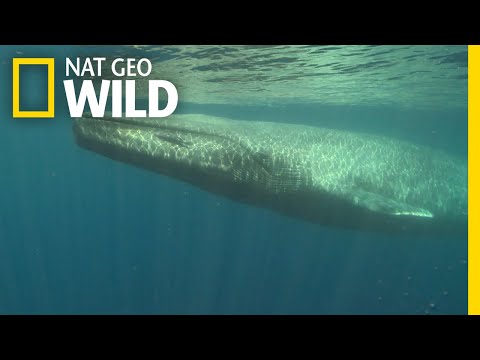
The blue whale, about 30 m long and up to 190 t, is the largest whale and the largest animal known to have lived. These are 14 living whale species ranked by maximum recorded length.
Pictured: a still from National Geographic’s “Blue Whales 101”, showing the blue whale, #1 with a maximum length of about 30 m.
Rank
Species
Max length (m)
Typical adult (m)
Max weight (t)
Diet
IUCN status
Range
Notes
1
Blue whale
~30
20–27
190
Baleen
Endangered
All oceans
Longest scientifically measured: 29.5 m; NOAA's “up to 110 ft” is not supported by measurements
2
Fin whale
26–27.3
18–24
65.5+
Baleen
Vulnerable
All oceans
Second-longest animal; weight estimates run from 65.5 to 120 t
3
Sei whale
19.5
12–18
~28
Baleen
Endangered
All oceans, mostly temperate
An alleged 22 m female (1911) is doubted and excluded; NOAA gives up to ~45 t
4
Sperm whale
~19 (males)
11–16
~57
Toothed
Vulnerable
All oceans
Largest toothed whale; claims of 24 m or more are unverified and excluded
5
North Atlantic right whale
18.5
13–16
~106
Baleen
Critically Endangered
Western North Atlantic
Heaviest measured specimen 106–108 t
6
Bowhead whale
~18
14–18
~100
Baleen
Least Concern
Arctic and subarctic
One alleged 19.5 m female (1800s) excluded; longest baleen of any whale
7
Southern right whale
17–18
13–15
~80
Baleen
Least Concern
Southern Hemisphere
Females about 15 m; records of 17–18 m
8
North Pacific right whale
17.4
15–18
~100
Baleen
Endangered
North Pacific
Largest officially recorded 17.4 m; an 18 m stranded female is also reported
9
Humpback whale
16–17
14–15
~40
Baleen
Least Concern
All oceans
NOAA says up to about 60 ft (18 m)
10
Bryde’s whale (complex)
15.5
12–14
~40
Baleen
Least Concern
Warm waters worldwide
A group of closely related species and forms; 15.51 m female off South Africa (1962)
11
Gray whale
14.9–15.2
11–15
~45
Baleen
Least Concern
North Pacific
Western North Pacific population is Critically Endangered
12
Baird’s beaked whale
~13
10–12
~14
Toothed
Least Concern
North Pacific
Second-largest toothed whale
13
Antarctic minke whale
11.9
7–9
~10
Baleen
Near Threatened
Southern Ocean
Longest, a Brazilian whaling catch (1969); most are under 10.7 m
14
Common minke whale
~10
7–9
~9
Baleen
Least Concern
North Atlantic and North Pacific
Alleged 10.7 m (1940, estimated by eye) excluded
No matching rows.
Read this first: the order is by maximum recorded length in metres, not weight; weight is shown but heaviest does not always mean longest (the bowhead and right whales are bulkier than the sei whale). “Whale” here means the baleen whales plus the sperm whale and beaked whales. Orcas (up to about 9.8 m) and pilot whales are technically dolphins, and dolphins and porpoises are left out. Maximum-length claims vary by source and whaling-era measurements were sometimes made by eye; single anecdotal or unverified claims (a 24 m sperm whale, a 22 m sei whale, a 19.5 m bowhead, a 10.7 m minke) are excluded, and figures come from NOAA Fisheries species pages, the IUCN Red List (via Wikipedia) and the published measurements Wikipedia cites. Weights are rounded estimates, not scale readings.
The Top 10
#1
Blue whale — ~30 m
The blue whale is the longest and heaviest animal known to have lived. Wikipedia gives a maximum confirmed length of about 30 m and a weight of up to 190 t, and the longest Antarctic blue whale scientifically measured was 29.5 m. NOAA Fisheries quotes “up to 110 feet” (33.5 m), which no measured animal supports, so the table uses ~30 m. Most adults are 20–27 m. It eats almost nothing but krill, and its status is Endangered after 20th-century whaling. The video is National Geographic’s “Blue Whales 101”.
#2
Fin whale — 26–27.3 m
The second-longest animal on Earth. The biggest individuals are reported at 26–27.3 m, with weights of 65.5 t or more (estimates go as high as 120 t); NOAA lists 75–85 ft (23–26 m) as the usual range. It is slimmer than the blue whale and one of the fastest large whales. Its status is Vulnerable. The video is BBC Earth’s footage of feeding fin whales in the North Atlantic.
#3
Sei whale — 19.5 m
Wikipedia calls it the third-largest rorqual: females in the Southern Hemisphere reach 19.5 m and the species up to about 28 t. NOAA gives 40–60 ft (12–18 m) for typical adults and up to 100,000 lb. An alleged 22 m female from 1911 is doubted and left out. Endangered. No video from an authoritative channel was verified, so the icon is used.
#4
Sperm whale — ~19 m
The largest toothed animal. Mature males are 15–16 m and the largest generally reach 18–19 m; an 18 m male is estimated at 57 t. NOAA lists 52 ft (16 m) for males. Historical claims of 24 m or more, including the whale that sank the Essex, are unverified and excluded. It hunts squid at depths of up to about 2,250 m. Vulnerable. The video is National Geographic’s “A Sperm Whale Family”.
#5
North Atlantic right whale — 18.5 m
The largest measured specimens were 18.5 m, weighing 106,000–108,000 kg; adults average 13–18 m. NOAA says up to 52 ft (16 m) and 140,000 lb. It is Critically Endangered, with entanglement and ship strikes the main threats. The video is NOAA Fisheries’ species spotlight.
#6
Bowhead whale — ~18 m
Adults usually measure 14–18 m and 75–100 t. One alleged 19.5 m female killed in the 1800s, and estimates of about 20 m, are not counted. It has the largest mouth of any animal and the longest baleen, and may live more than 200 years. NOAA lists up to 62 ft (19 m) and 200,000 lb. Least Concern. The video is a National Geographic Live talk in which Paul Nicklen describes photographing a bowhead; it is not a species documentary.
#7
Southern right whale — 17–18 m
Adult females are about 15 m, with larger records of 17–18 m and up to 80 t. NOAA lists 43–56 ft (13–17 m) and up to 176,000 lb. It is Least Concern after recovering from whaling. The video is Nat Geo Animals’ clip on a sanctuary for southern right whales.
#8
North Pacific right whale — 17.4 m
The largest officially recorded specimen was 17.4 m; adults are often given as 15–19 m, and an 18 m female stranded on Japan’s Izu Peninsula. NOAA lists 45–64 ft and up to 100 tons. Endangered, with only a small eastern population. The video is NOAA Fisheries’ “Right Whales of the Pacific”.
#9
Humpback whale — 16–17 m
Adults are usually 14–15 m, with individuals of 16–17 m recorded and weights up to 40 t; females are 1–1.5 m longer than males. NOAA says up to about 60 ft (18 m). Least Concern. The video is National Geographic WILD UK’s clip on humpback migration to Australia.
#10
Bryde’s whale (complex) — 15.5 m
The longest measured was a 15.51 m female caught off South Africa in 1962, with weights estimated at up to 40 t (typically 12–25 t). It is a group of closely related forms, treated here as one row, and Least Concern overall. No authoritative video was verified, so the icon is used.
Videos on YouTube from National Geographic, BBC Earth and NOAA Fisheries; each ID was checked for channel and title. The bowhead video is a general talk, and the sei and Bryde’s entries have no verified video.