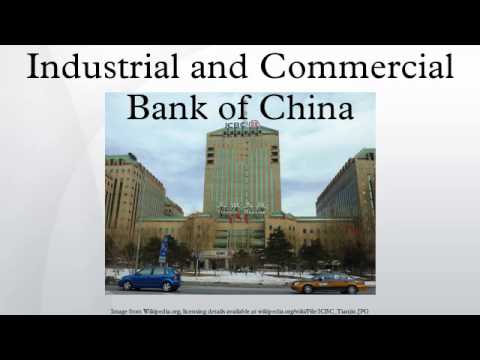
Ranked by total assets as of year-end 2025 — China's "Big Four" state-owned banks occupy the top four spots outright, and Chinese lenders account for six of the top fifteen.
Pictured: ICBC, #1 with $7.65 trillion in total assets.
Rank
Bank
Total assets
Country
1
ICBC
$7.65T
China
2
Agricultural Bank of China
$6.97T
China
3
China Construction Bank
$6.52T
China
4
Bank of China
$5.50T
China
5
JPMorgan Chase
$4.43T
United States
6
Bank of America
$3.41T
United States
7
BNP Paribas
$3.28T
France
8
HSBC Holdings
$3.21T
United Kingdom
9
Crédit Agricole Group
$3.15T
France
10
Postal Savings Bank of China
$2.76T
China
11
Mitsubishi UFJ Financial Group
$2.72T
Japan
12
Citigroup
$2.66T
United States
13
Bank of Communications
$2.20T
China
14
Wells Fargo
$2.15T
United States
15
Sumitomo Mitsui Financial Group
$1.98T
Japan
No matching rows.
The Top 10
#1
ICBC — $7.65 trillion
State-owned and headquartered in Beijing, Industrial and Commercial Bank of China has held the title of the world's largest bank by assets for well over a decade, a run no rival on this list has come close to matching. Its 2006 initial public offering raised $21.9 billion and was, at the time, the largest IPO in history, debuting simultaneously on the Shanghai and Hong Kong exchanges.[1]
#2
Agricultural Bank of China — $6.97 trillion
Originally founded to serve China's rural economy, ABC now operates one of the largest branch networks of any bank on Earth, spanning thousands of towns and villages alongside major cities. Its own 2010 initial public offering briefly topped ICBC's as the largest ever, raising $22.1 billion before Alibaba's 2014 listing eclipsed it.[1]
#3
China Construction Bank — $6.52 trillion
One of China's "Big Four" state-owned banks, CCB is especially dominant in mortgage lending and infrastructure finance, underwriting much of the country's decades-long construction boom. Founded in 1954 as the People's Construction Bank of China, it originally existed solely to finance state infrastructure projects like dams and railways before becoming a full commercial bank in 1994.[1]
#4
Bank of China — $5.50 trillion
The oldest continuously operating bank in China, tracing its roots to 1912, Bank of China is also the country's most internationally focused lender, with operations across more than 60 countries. Its Hong Kong headquarters occupies the Bank of China Tower, a 1989 I. M. Pei-designed skyscraper that was, for a few years, the tallest building in Asia.[1]
#5
JPMorgan Chase — $4.43 trillion
The largest bank in the United States and the only non-Chinese lender in the global top five, JPMorgan Chase has extended its lead over domestic rivals through steady growth across consumer banking, investment banking, and asset management. Its lineage traces back to 1799 and the Manhattan Company, a water-utility venture chartered with the backing of Aaron Burr and Alexander Hamilton that later became a bank.[1]
#6
Bank of America — $3.41 trillion
The second-largest bank in the United States and the only other American lender in the global top ten besides JPMorgan Chase, Bank of America took its current form in 1998 when Charlotte-based NationsBank acquired the original BankAmerica Corporation and adopted its name. That original bank was founded in San Francisco in 1904 as the Bank of Italy by Amadeo Giannini, who built it by lending to immigrant and working-class customers other banks turned away.[1]
#7
BNP Paribas — $3.28 trillion
France's largest bank and the only bank headquartered outside Asia or North America to crack the global top ten, BNP Paribas operates retail and corporate banking across more than 60 countries. Its 2000 merger followed a bruising three-way takeover battle in 1999, in which BNP fended off a rival bid from Société Générale and ended up acquiring Paribas outright instead.[1]
#8
HSBC Holdings — $3.21 trillion
Headquartered in London but built on 19th-century roots as the Hongkong and Shanghai Banking Corporation, HSBC still draws much of its profit from Asia, giving it one of the most genuinely global footprints of any bank on this list. It was founded in 1865 by Scottish businessman Thomas Sutherland to finance the booming trade in tea, silk, and cotton between Asia, Europe, and North America, opening in Hong Kong and Shanghai within a month of each other.[1]
#9
Crédit Agricole Group — $3.15 trillion
France's largest cooperative bank grew out of a 19th-century network of regional agricultural credit unions, a mutualist ownership structure it still retains today even as its investment-banking arm, Crédit Agricole CIB, competes globally. That agricultural heritage still earns it the nickname "la banque verte," the green bank, and the group today comprises 39 regional banks bound together under a shared cooperative structure.[1]
#10
Postal Savings Bank of China — $2.76 trillion
Converted from a postal-service savings arm into a full commercial bank in 2007 and listed on the Hong Kong and Shanghai exchanges in 2016 and 2019 respectively, Postal Savings Bank of China is the youngest of the six Chinese lenders in the global top fifteen, with a nationwide network of post-office branches that gives it deeper reach into rural China than any of its larger state-owned peers. That network traces back to 1919, when China's post offices first began taking deposits, decades before the postal-savings arm was spun off into a standalone bank.[1]
S&P Global Market Intelligence, "The world's largest banks by assets, 2026," ranked by total assets as of December 31, 2025 (figures in USD); founding dates, IPO history, and corporate-history background for each bank aggregated from company histories and financial-press reference sources.
Company annual reports and SEC filings for JPMorgan Chase, Bank of America, Citigroup, and Wells Fargo, year-end 2025.