A sovereign wealth fund is a state-owned investment fund that invests in real and financial assets. Norway’s Government Pension Fund Global is the largest at about $2.5 trillion, ahead of China’s SAFE Investment Company ($2.0 trillion) and China Investment Corporation ($1.6 trillion). Fund sizes are mostly tracker estimates, as of November 2026.
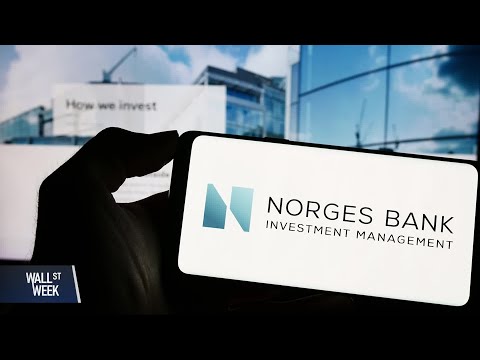
Pictured: Bloomberg Television on the investment philosophy of Norway’s sovereign wealth fund, #1 at $2,499 billion.
Rank
Fund
Country
Assets ($B)
Founded
Source of funds
Region
1
Government Pension Fund Global (NBIM)
Norway
2,499
1990
Oil & gas
Europe
2
SAFE Investment Company
China
2,047
1997
Non-commodity
Asia
3
China Investment Corporation (CIC)
China
1,567
2007
Non-commodity
Asia
4
GIC
Singapore
1,181
1981
Non-commodity
Asia
5
Abu Dhabi Investment Authority (ADIA)
United Arab Emirates
1,180
1976
Oil & gas
Middle East
6
Kuwait Investment Authority (KIA)
Kuwait
1,072
1953
Oil & gas
Middle East
7
Public Investment Fund (PIF)
Saudi Arabia
900
1971
Oil & gas
Middle East
8
Danantara (Daya Anagata Nusantara)
Indonesia
900
2025
Non-commodity
Asia
9
Qatar Investment Authority (QIA)
Qatar
600
2005
Oil & gas
Middle East
10
Hong Kong Exchange Fund (HKMA)
Hong Kong
569
1935
Non-commodity
Asia
11
Temasek Holdings
Singapore
568
1974
Non-commodity
Asia
12
National Council for Social Security Fund (NSSF)
China
503
2000
Non-commodity
Asia
13
Investment Corporation of Dubai (ICD)
United Arab Emirates
457
2006
Oil & gas
Middle East
14
Turkey Wealth Fund (TWF)
Turkey
442
2017
Non-commodity
Middle East
15
Mubadala Investment Company
United Arab Emirates
385
2002
Oil & gas
Middle East
16
Abu Dhabi Developmental Holding (ADQ)
United Arab Emirates
271
2018
Non-commodity
Middle East
17
Korea Investment Corporation (KIC)
South Korea
232
2005
Non-commodity
Asia
18
Future Fund
Australia
184
2006
Non-commodity
Oceania
No matching rows.
As of November 2026. Assets are in billions of US dollars, taken from the Sovereign Wealth Fund Institute (SWFI) figures as compiled in Wikipedia’s “List of sovereign wealth funds” (SWFI entries retrieved between March 2025 and September 2026, so individual figures carry different dates).[1] The rule: state-owned investment funds with a sovereign mandate, as that source defines them. Singapore’s Central Provident Fund (a public pension fund, $436 billion in the source) is left out, as are central-bank reserve managers such as Saudi Arabia’s SAMA; China’s NSSF and Hong Kong’s Exchange Fund stay because the source lists them as sovereign wealth funds. Iran’s National Development Fund and Russia’s National Wealth Fund are omitted because their figures are opaque and unverifiable. Many funds, including SAFE, ADIA, GIC and KIA, do not publish asset totals, so these are estimates and other trackers differ. Unlike RList’s other money rankings, this lists state investors rather than companies, banks or countries’ wealth.[1][3]
The Top 10
#1
Norway — Government Pension Fund Global, $2,499B
Managed by Norges Bank Investment Management and funded by the state’s oil and gas revenue, the fund was worth NOK 22,683 billion at the end of June 2026, with 72.1% in equities and 25.8% in fixed income.[2] It posted the highest half-year krone return on record in the first half of 2026 (9.4%).[2] The ranking table uses the SWFI dollar figure from the common source, which is higher than the roughly $2.3 trillion that press reports gave for the end of June.[1][2]
#2
China — SAFE Investment Company, $2,047B
SAFE Investment Company is the investment arm of China’s State Administration of Foreign Exchange and invests part of the country’s foreign-exchange reserves.[1] It does not publish official asset figures, so its size is a tracker estimate, and estimates for it range widely; this is the least certain of the top-three numbers.[1][3]
#3
China — China Investment Corporation, $1,567B
CIC was set up in 2007 to invest part of China’s foreign-exchange reserves.[1] The $1,567 billion shown is the total-assets figure; a secondary summary of its annual report also cites about $1.37 trillion of net assets, so the number depends on whether liabilities are subtracted.[3]
#4
Singapore — GIC, $1,181B
GIC manages Singapore’s foreign reserves and was founded in 1981.[1] It does not disclose its total assets, so the figure is an estimate; another tracker-based summary puts it between about $800 billion and $940 billion, which would move it down the table.[3] It reports a 20-year annualised real return rather than a headline size.[1][3]
#5
United Arab Emirates — ADIA, $1,180B
ADIA, founded in 1976, is the largest of Abu Dhabi’s state funds and is funded by oil revenue.[1] It does not publish official asset figures, and estimates sit around $1.1 trillion to $1.2 trillion.[3] The video, from CNBC, looks at Abu Dhabi’s group of state investors, including ADIA, Mubadala and ADQ.[4]
#6
Kuwait — Kuwait Investment Authority, $1,072B
KIA traces its origin to the Kuwait Investment Board of 1953, before Kuwait’s independence in 1961, and is often called the world’s oldest sovereign wealth fund; it became an autonomous authority under a 1982 law.[5] Oil revenue funds it, and its assets are not publicly disclosed, so the figure is an estimate.[1][3]
#7
Saudi Arabia — Public Investment Fund, $900B
PIF reported assets of $913 billion at the end of 2024, and the tracker figure here is a round $900 billion.[1][3] It is the main vehicle for Saudi Arabia’s economic-diversification plans. The video is the announcement of its 2021–2025 strategy.[6] It ties with Danantara on this table; the older fund is listed first.
#8
Indonesia — Danantara, $900B
Indonesia launched Danantara on February 24, 2025 as a holding vehicle for state-owned enterprises, with a stated target of about $900 billion in assets.[7] It is by far the youngest fund in the table, and its size comes from consolidating state companies rather than from commodity savings, so it is not directly comparable with a cash-based fund.[1][7]
#9
Qatar — Qatar Investment Authority, $600B
Founded in 2005 and funded by Qatar’s natural-gas revenue, QIA does not publish its total assets; other summaries put it at about $500 billion to $560 billion, below this table’s $600 billion.[1][3] The video is a CNBC interview with its chief executive.[8]
#10
Hong Kong — Exchange Fund, $569B
The Exchange Fund, run by the Hong Kong Monetary Authority and dated to 1935 in the source, backs the Hong Kong dollar rather than saving commodity income.[1] It is a currency reserve pool, which is why some trackers treat it as a central-bank asset; this ranking keeps it because the common source lists it as a sovereign wealth fund.[1]
Wikipedia, “List of sovereign wealth funds” (en.wikipedia.org), which cites the Sovereign Wealth Fund Institute (swfinstitute.org) profiles for each fund’s assets, inception and origin; the Norway entry was retrieved September 20, 2026 and the SAFE entry March 6, 2025. SWFI’s own ranking table is paywalled.
Norges Bank Investment Management, half-year report 2026 and press release “Record high krone return in the first half of the year” (nbim.no: NOK 22,683 billion at June 30, 2026; 9.4% return; equities 72.1%, fixed income 25.8%).
Altss, “Largest sovereign wealth funds” (altss.com) and Universal Asset Owners, “The world’s largest sovereign wealth funds 2026” (universalassetowners.com): secondary estimates and ranges used only to flag uncertainty; PIF’s end-2024 $913 billion as reported by the fund.
YouTube, CNBC International Live, “Abu Dhabi Inc: Decoding the capital’s $1.7 trillion sovereign wealth funds”.
YouTube, Al Arabiya English, “Saudi Crown Prince announces Public Investment Fund 2021 2025 strategy”.
YouTube, CNA, “Indonesia launches sovereign wealth fund Danantara, aiming to hold US$900 billion in assets”; Kompas TV on the February 24, 2025 launch.
YouTube, CNBC International Live, “Full Interview: Qatar’s Investment Authority CEO Mansoor Al Mahmoud”. Norway video: Bloomberg Television, “Norway Sovereign Wealth Fund’s Investment Philosophy”; GIC video: GIC, “GIC: Work at the Point of Impact”.