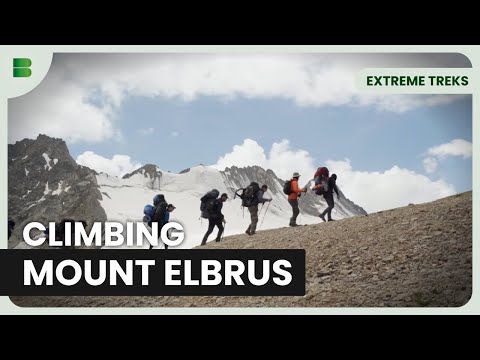
Under the standard convention that includes the Caucasus, six of Europe's ten tallest peaks tower well above anything in the Alps — ranked here by elevation above sea level.
Pictured: Mount Elbrus in the Russian Caucasus, #1 at 5,642 m.
Rank
Mountain
Elevation
Range
1
Mount Elbrus
5,642 m
Caucasus
2
Dykh-Tau
5,205 m
Caucasus
3
Shkhara
5,201 m
Caucasus
4
Koshtan-Tau
5,151 m
Caucasus
5
Jangi-Tau
5,085 m
Caucasus
6
Kazbek
5,054 m
Caucasus
7
Mont Blanc
4,808 m
Alps
8
Dufourspitze
4,634 m
Alps
9
Dom
4,545 m
Alps
10
Liskamm
4,527 m
Alps
11
Weisshorn
4,505 m
Alps
12
Matterhorn
4,478 m
Alps
No matching rows.
The Top 10
#1
Mount Elbrus — 5,642 m
A dormant volcano with two summits in Russia's Caucasus — the higher Western peak and a slightly shorter Eastern one — Elbrus is conventionally ranked Europe's highest point and counted among the Seven Summits, even though it's more than 800 m taller than Mont Blanc. Most climbers tackle the south side, where a cable car ferries them up to around 3,658 m before the real climbing begins. Despite that relatively gentle approach, Elbrus is deceptively dangerous: sudden storms and whiteout conditions kill roughly 15 to 30 climbers most years, more than any other of the Seven Summits.[1]
#2
Dykh-Tau — 5,205 m
Despite standing lower than Elbrus, Dykh-Tau is a far more serious technical climb, with no straightforward route to its summit and only a handful of ascents most years. Its name translates to "Jagged Mountain," a fitting description for the second-highest peak in the Caucasus. British mountaineer Albert Mummery and his Swiss guide Heinrich Zurfluh made the first ascent in 1888 via the southwest buttress — a route now abandoned in favor of the North Ridge, the modern standard line.[2]
#3
Shkhara — 5,201 m
Shkhara is the highest point in the country of Georgia, sitting right on the border with Russia at the head of the dramatic Bezengi Wall — an 11-to-12-kilometer ridge shared with Dykh-Tau, Koshtan-Tau, and Jangi-Tau. British climbers John Cockin and Ulrich Almer, with guide Christian Roth, made the first ascent in 1888 via the northeast ridge, still the standard route today. Its routes range from Russian grade 4B up to 6B, making Shkhara one of Europe's toughest technical climbs.[3]
#4
Koshtan-Tau — 5,151 m
Tucked deep in the remote Bezengi region, Koshtan-Tau's name roughly translates to "paired mountain," and it remains one of the least-visited of Europe's highest summits. British mountaineer Herman Woolley, guided by Christian Jossi and Ulrich Almer, made the first ascent in 1889 — a year after Dykh-Tau, Shkhara, and Ushba had all fallen during the "golden age" of Caucasus climbing. Alongside Shkhara, it forms part of the same forbidding Bezengi Wall, whose technical routes rank among the range's most demanding.[4]
#5
Jangi-Tau — 5,085 m
A three-peaked massif straddling the Georgia–Russia border, Jangi-Tau (also spelled Dzhangi-Tau) sits in the same Bezengi Wall cluster as Dykh-Tau, Shkhara, and Koshtan-Tau, making this stretch of the Caucasus the single densest concentration of very tall peaks in Europe. Its heavily glaciated slopes hide dormant volcanic vents beneath the ice, and the massif actually comprises three distinct summits: the main peak at 5,085 m, plus a West Peak (5,059 m) and East Peak (5,034 m). A team led by R. Schwarzgruber first reached the main summit via the northeast ridge in 1935.[5]
#6
Kazbek — 5,054 m
A dormant stratovolcano on the Georgia–Russia border, Kazbek looms over the tiny Gergeti Trinity Church perched on a ridge below it, making the pair one of the most photographed mountain scenes in the Caucasus. Built in the 14th century, the church once served as a refuge for sacred relics during times of invasion. Georgian legend holds that Kazbek is where the Titan-like hero Amirani — a local parallel to Prometheus — was chained by the gods for giving fire to humanity, doomed to have an eagle peck at his liver for eternity.[6]
#7
Mont Blanc — 4,808 m
The highest peak in the Alps and long considered Western Europe's high point, Mont Blanc straddles the France–Italy border; its first ascent in 1786, by Jacques Balmat and Michel Paccard, is widely regarded as the birth of modern mountaineering. Its summit height isn't fixed — a snow and ice cap up to 23 m thick sits atop the rock, so surveyors remeasure it roughly every two years, and a 2023 survey found the mountain had shrunk by over two meters in just two years. An 11.6 km road tunnel bores beneath the massif, connecting the French town of Chamonix to Courmayeur in Italy.[7]
#8
Dufourspitze — 4,634 m
The highest summit of the Monte Rosa massif and the tallest point in Switzerland, Dufourspitze is named after Guillaume-Henri Dufour, the Swiss general and cartographer who led the country's first national topographic survey. It was first climbed on 1 August 1855 — coincidentally Switzerland's national day — by a party of eight led by guides Matthäus and Johannes Zumtaugwald and Ulrich Lauener. The peak was originally known simply as Höchste Spitze ("Highest Point") until Switzerland's Federal Council renamed it in Dufour's honor in 1863, and it remains the second-highest summit in the Alps after Mont Blanc.[8]
#9
Dom — 4,545 m
Rising above the village of Randa in the Mischabel range, the Dom is the highest peak located entirely within Switzerland — Dufourspitze's higher summit sits right on the Swiss–Italian border, leaving the Dom to claim that particular distinction. The Mischabel name derives from the word for "fork," describing how the Dom, Täschhorn, and Lenzspitze rise together like the prongs of a trident along a range that stretches six kilometers and holds seven separate 4,000-metre summits. J. Llewellyn Davies and local guides made the first ascent via the northwest ridge on 11 September 1858.[9]
#10
Liskamm — 4,527 m
Part of the Monte Rosa massif, Liskamm carries a long, heavily corniced summit ridge prone to sudden collapse, earning its standard route a reputation as one of the more dangerous normal routes among the Alps' 4,000-metre peaks. Climbers nicknamed it the Menschenfresser — "Man Eater" — after a string of fatal accidents on its traverse. The grimmest came in 1877, when a cornice gave way beneath two English climbers and their three guides, sweeping all five to their deaths thousands of feet below.[10]