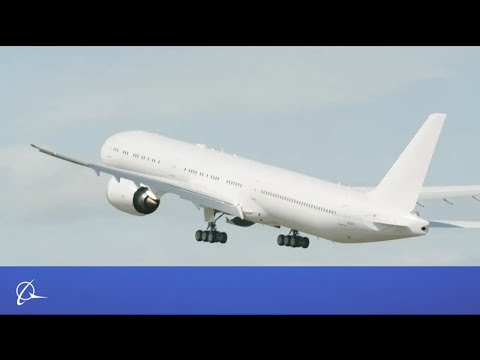
From the Boeing 777-9 (76.7 m, not yet in service) to the 747-8 and Airbus A340-600, 13 passenger airliner types ranked by overall length, with wingspan, weight and seats. The A380 is still the heaviest and the widest.
Pictured: the Boeing 777-9 on its first flight in January 2020, #1 with a length of 76.72 m. It has not yet entered passenger service; the 747-8 Intercontinental (#2, 76.25 m) is the longest airliner flying today.
Rank
Aircraft
Length (m)
Wingspan (m)
Max takeoff weight (tonnes)
Typical seats
Max seats
Maker
First flight
Status
1
Boeing 777-9
76.72
71.8
351.5
426
—
Boeing
2020
Not yet in service (certification)
2
Boeing 747-8 Intercontinental
76.25
68.4
447.7
467
605
Boeing
2011
In service (production ended 2023)
3
Airbus A340-600
75.36
63.45
380
380
475
Airbus
2001
Mostly retired
4
Boeing 777-300ER
73.86
64.8
351.5
365
550
Boeing
2003
In service
5
Airbus A350-1000
73.79
64.75
322
369
480
Airbus
2016
In production
6
Airbus A380-800
72.72
79.75
575
525
853
Airbus
2005
In service (production ended 2021)
7
Boeing 747-400
70.66
64.4
396.9
416
—
Boeing
1988
Mostly retired
8
Boeing 787-10
68.28
60.12
254
330
440
Boeing
2017
In production
9
Airbus A340-500
67.93
63.45
380
313
375
Airbus
2002
Mostly retired
10
Airbus A350-900
66.8
64.75
283
325
440
Airbus
2013
In production
11
Boeing 777-200LR
63.73
64.8
347.5
301
—
Boeing
2005
In service
12
Airbus A330-300
63.66
60.3
242
300
440
Airbus
1992
In service
13
Boeing 787-9
62.81
60.12
254
290
406
Boeing
2013
In production
No matching rows.
Ranking rule: each row is one passenger-airliner type, the longest variant of its family or sub-family, ranked by overall length in metres (nose to tail) from the manufacturers’ airport-planning data as reproduced on Wikipedia and cross-checked against Airbus and Boeing figures (see Sources). The 777 and 747 appear twice because a newer, longer type is a separate model (777-9 and 777-300ER; 747-8 and 747-400); the 787 and A350 appear twice as separate lengths (787-10 and 787-9; A350-1000 and A350-900), and the A340-600 and A340-500 are listed separately. Typical seats is the manufacturer’s typical layout, two or three classes depending on the maker (777-9, A350-1000, 787 and A330-300 are two-class, the others three-class); Max seats is the highest certified or published figure, mostly a single-class limit, left blank (—) where no reliable figure was found. Wingspan is the in-flight span (the 777-9’s tips fold to 64.8 m); weight is the highest published maximum takeoff weight. Status as of October 2026: the 777-9 has flown but not entered service; “mostly retired” means few remain in passenger use. Left out: cargo-only aircraft such as the Antonov An-225 (84 m) and freighters, the 747SP (56 m) and the unflown 777-8 (about 69.5 m). The table stops at the 62.81 m 787-9.[1]
The Top 10
#1
Boeing 777-9 — 76.72 m
The longest passenger airliner ever designed. The 777-9 stretches the 777 by three seat rows to 76.72 m (251 ft 9 in) and, with its folding wingtips extended, spans 71.8 m; folded for the gate it fits within 64.8 m. Boeing seats about 426 in two classes (375–450) or 349–357 in three. It first flew on January 25, 2020, but has not entered service: Boeing has said it needs all of 2026 to finish FAA certification, with the first delivery, to Lufthansa, slipping to 2027, so it tops this table on paper rather than in the air.[2]
#2
Boeing 747-8 Intercontinental — 76.25 m
The longest airliner actually flying passengers. Boeing stretched the 747-400 by 5.6 m to 76.25 m (250 ft 2 in) and gave it a new wing (68.4 m span) and a 447.7-tonne maximum takeoff weight. It first flew on March 20, 2011, and Lufthansa began passenger service in June 2012. Boeing's airport-planning figure is 467 seats in three classes; the 747-8 program ended when the last 747, a freighter, was delivered on January 31, 2023.[3]
#3
Airbus A340-600 — 75.36 m
Airbus’s stretched four-engine long-haul jet first flew on April 23, 2001 and is more than 4 m longer than a 747-400 and 2.6 m longer than the A380. Its typical layout seats 380 (12 first, 54 business, 314 economy) with a 440–475 exit limit and a 380-tonne maximum weight. It was outsold by the Boeing 777-300ER, Airbus ended the A340 program in 2011, and airlines are retiring the survivors; Lufthansa announced it was withdrawing its A340-600s from scheduled service in 2025.[4]
#4
Boeing 777-300ER — 73.86 m
The best-selling long-haul twinjet, 73.86 m (242 ft 4 in) long with a 64.8 m wingspan and a 351.5-tonne maximum takeoff weight. Boeing lists 365 seats in three classes and 396 in two; it first flew in 2003. The video shows Emirates, the type’s largest operator, taking its last 777-300ER.[5]
#5
Airbus A350-1000 — 73.79 m
The longest Airbus now in production, first flown on November 24, 2016. Airbus puts 369 passengers in a typical two-class layout and certified up to 480 seats from November 2019; its maximum takeoff weight was raised to 322 tonnes in October 2023. At 73.79 m it is just 0.07 m shorter than the 777-300ER.[6]
#6
Airbus A380-800 — 72.72 m
Only sixth by length but first by every other measure: the A380 spans 79.75 m, weighs up to 575 tonnes at takeoff and is certified for 853 passengers (Airbus’s typical layout is 525). It first flew on April 27, 2005, entered service with Singapore Airlines on October 25, 2007, and production ended in 2021.[7]
#7
Boeing 747-400 — 70.66 m
The classic jumbo, 70.66 m long with winglets and a 64.4 m span; the earlier 747-100, -200 and -300 share the same length. It first flew on April 29, 1988 and entered service with Northwest Airlines on February 9, 1989, seating 416 in three classes. Passenger airlines have retired most of them, though a few remain in limited service.[8]
#8
Boeing 787-10 — 68.28 m
The longest Dreamliner, 5.5 m longer than the 787-9, first flown on March 31, 2017. Boeing seats 330 in two classes and up to 440 in one, with a 254-tonne maximum takeoff weight on a 60.12 m wing.[9]
#9
Airbus A340-500 — 67.93 m
The ultra-long-range A340 variant, 67.93 m long with the same 63.45 m wing as the -600 and a 380-tonne weight. Airbus lists a typical 313 seats in three classes and an exit limit of 375. Singapore Airlines used it for its nonstop Singapore–Newark and Los Angeles flights, and it has since left most fleets.[4]
#10
Airbus A350-900 — 66.80 m
The first A350, flown on June 14, 2013 and in service with Qatar Airways since January 15, 2015. It is 66.80 m long with a 64.75 m span and weighs up to 283 tonnes; Airbus quotes 300–350 typical seats and 440 at most.[6]
Wikipedia aircraft pages for the Boeing 777, 777X, 747-8, 747-400, 787, Airbus A330, A340, A350 and A380 (en.wikipedia.org/wiki/Boeing_777X and the others), read October 2026, citing Boeing’s and Airbus’s airport-planning documents for lengths, spans, weights and seating.
Boeing 777X page (777-9: 76.73 m, 71.76 m span, first flight January 25, 2020); reporting on the certification schedule, including Aviation Week, Airdata News and Emirates coverage that first delivery has moved to 2027; Boeing video “Boeing 777-9 Takes Off for Its First Flight”.
Boeing, “747-8 Airplane Characteristics for Airport Planning” (August 2023), via Wikipedia “Boeing 747-8”; The Seattle Times video of the first flight.
Wikipedia, “Airbus A340” (A340-500 and -600 specification table; end of program announced November 10, 2011); Airbus aircraft data; Lufthansa retirement reports, 2025.
Wikipedia, “Boeing 777” (777-300ER and 777-200LR specification table); Emirates video of its last 777-300ER delivery; PlaneFYI and Singapore Airlines fleet pages for seat counts.
Wikipedia, “Airbus A350”; Airbus, “A350 Airport Characteristics” (December 2024); JAL and SKYbrary A350-1000 data; Airbus videos of the A350-1000 and A350-900 first flights.
Wikipedia, “Airbus A380” (specification table); Airbus A380 aircraft characteristics for airport planning; Emirates A380 video.
Wikipedia, “Boeing 747-400” (first flight April 29, 1988; 416 seats in three classes; 70.66 m).
Wikipedia, “Boeing 787 Dreamliner” (787-8, -9 and -10 characteristics table); Boeing video of the 787-10 first flight.