Vehicles & Machines
The Countries with the Longest High-Speed Rail Networks
China’s high-speed rail network is 50,400 km long, about 13 times Spain’s, the world’s second largest. This ranking measures how much high-speed track each country operates, using the UIC definition (new lines built for 250 km/h or more, plus upgraded lines run at 200 km/h or more) and 2025 figures, as of October 2026. It is different from The Fastest Trains in the World, which ranks individual trains by speed.
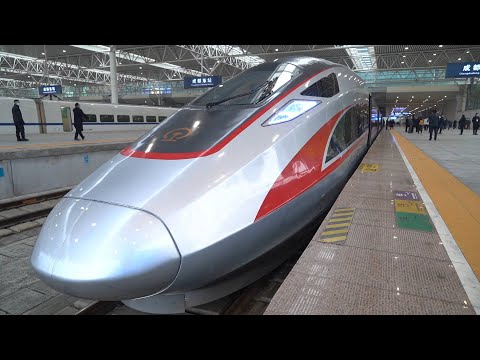
Pictured: Fuxing bullet trains entering service on China’s Chengdu–Chongqing high-speed railway; China is #1 with 50,400 km.
As of October 2026; length figures are for 2025. Operating length is high-speed track in service, not under construction or planned. The UIC counts new lines built for 250 km/h or faster and upgraded lines run at 200 km/h or faster. All lengths come from one UIC-based country table, so the countries are comparable with each other.[1] Totals are very sensitive to the definition: the UIC-style count gives France 3,517 km and Germany 2,683 km, but counts of dedicated lines only are lower (about 2,800 km for France, about 1,658 km for Germany), which would put Japan ahead of France.[5] The UK, Sweden and Uzbekistan figures include upgraded lines. “Top operating speed” is the highest speed used in regular service, not a design or test speed; China’s first line is listed as Qinhuangdao–Shenyang (2003), although Beijing–Tianjin (2008) was its first 350 km/h line. The UK’s year is that of High Speed 1’s first section. Countries below 1,100 km, including Turkey, Finland, Taiwan, Russia and Poland, are not listed because published lengths for them disagree between sources.[1]
The Top 10
#1
China — 50,400 km
China’s 50,400 km is more than 12 times the length of Spain’s network, the second largest. Its first dedicated line, Qinhuangdao–Shenyang, opened in 2003 at 200 km/h; the Beijing–Tianjin line followed on August 1, 2008 and became the first to run at 350 km/h.[2] Another 19,600 km is listed as under construction, and the CR450, with a planned service speed of 400 km/h, entered pre-service trials in October 2025.[1][2] The video shows Fuxing trains entering service on the Chengdu–Chongqing line.
#2
Spain — 3,973 km
Spain’s first high-speed line, Madrid–Seville, opened on April 21, 1992, in time for Expo ’92.[3] Its network now runs to 3,973 km, the largest in Europe, with another 1,034 km under construction.[1] Quartz, citing UIC data for 2024, gives a slightly higher 3,993 km.[4] The video covers the history of the first AVE Series 100 trains.
#3
France — 3,516 km
France’s first TGV line, Paris–Lyon (LGV Sud-Est), opened in 1981.[1] The table figure of 3,517 km follows the UIC definition; France’s own count of dedicated LGV lines is about 2,800 km, which would drop France behind Japan in this ranking.[5] TGV trains hold the 574.8 km/h rail speed record in testing, but in service they run at up to 320 km/h.
#4
Japan — 3,067 km
The Tokaido Shinkansen between Tokyo and Osaka opened in 1964, the world’s first high-speed line.[1] Japan’s network now totals 3,067 km. The N700S, introduced on the Tokaido line on July 1, 2020, reached 360 km/h in testing but is limited to 285 km/h in passenger service.[6]
#5
Germany — 2,683 km
The UIC-style count gives Germany 2,683 km, but that includes upgraded lines; Wikipedia’s Europe overview puts dedicated high-speed lines at about 1,658 km.[1][5] The first ICE lines, Hannover–Würzburg, opened in 1991. The ICE 3neo entered passenger service on December 5, 2022, between Frankfurt and Cologne, with a top speed of 320 km/h.[7]
#6
Sweden — 1,711 km
Sweden ranks sixth because the UIC definition counts lines upgraded for 200 km/h running, not only new 250 km/h lines.[1] Its X2000 tilting trains began service in 1990 and still top out at 200 km/h, the lowest speed in this table.[1]
#7
South Korea — 1,549 km
South Korea’s KTX launched on April 1, 2004, using trains based on Alstom’s TGV Réseau.[8] Regular service tops out at 305 km/h, although the infrastructure is designed for 350 km/h.[8] The video covers the domestically built KTX-Sancheon.
#8
United Kingdom — 1,485 km
The UK figure of 1,485 km includes upgraded main lines run at about 200 km/h (125 mph), a definition that gives Britain a far larger network than its dedicated high-speed track. Only High Speed 1, between London St Pancras and the Channel Tunnel, is a purpose-built 300 km/h line; it was completed in 2007.[1][5] Its first section opened in 2003.[5]
#9
Italy — 1,312 km
Italy’s Florence–Rome “Direttissima” opened in 1977, the first high-speed line in Europe.[5] The network totals about 1,312 km, run by Frecciarossa and Italo trains at up to 300 km/h; the Frecciarossa 1000 is designed for 400 km/h.[5][9]
#10
Uzbekistan — 1,161 km
Uzbekistan’s Afrosiyob trains began running on the upgraded Tashkent–Samarkand line in 2011, and the Tashkent–Bukhara line opened on October 8, 2011.[10] The Spanish-built Talgo 250 sets are rated at 250 km/h but run at about 230 km/h commercially, and the 1,161 km total is for the network as a whole.[10]
Sources
- Wikipedia, “List of high-speed railway lines” (country table, operational length in km, top speed and opening year, based on International Union of Railways (UIC) figures, map dated 2025); UIC definition of high-speed rail (250 km/h new lines, 200 km/h upgraded lines).
- Wikipedia and railway-technology.com on China’s Qinhuangdao–Shenyang (2003) and Beijing–Tianjin (August 1, 2008) lines; China Daily, “World’s fastest high-speed train blazes to 453 km/h in pre-service trials” (October 21, 2025); YouTube, “Faster Fuxing bullet trains put into use on Chengdu-Chongqing high-speed railway”.
- The Objective, “El AVE cumple 30 años” (April 21, 2022, on the April 21, 1992 opening of Madrid–Seville); YouTube, “El Tren que CAMBIÓ España: La Historia y Secretos del AVE Serie 100 de Renfe”.
- Quartz, “Countries with the most high-speed rail: 8 ranked by length”, citing UIC data for 2024 (Spain 3,993 km); used as a cross-check on Spain, France and Germany.
- Wikipedia, “High-speed rail in Europe” (dedicated-line lengths: France about 2,800 km as of June 2021, Germany about 1,658 km, Italy 1,342 km, UK HS1 108 km); French Ministry of Ecology, “Projets de lignes à grande vitesse” (about 2,800 km of LGV); YouTube, France 24, “Fast, green and convenient: Exploring the ins and outs of France’s TGV”.
- Railway Gazette International, “Series N700S enters service on Tokaido Shinkansen” (July 1, 2020); Scroll.in on the 360 km/h N700S test run; YouTube, “N700S The next generation Shinkansen N700 Supreme J0 formation trial test run JR Central”.
- Railway Gazette International, “DB orders more ICE3neo sets as first unit is unveiled”; The Local, “ICE 3neo: Deutsche Bahn’s speediest train makes first trip in Germany” (December 5, 2022); YouTube, “Deutsche Bahn nimmt neusten ICE 3neo in Betrieb”.
- Wikipedia, “KTX” (service launched April 1, 2004, 305 km/h in regular service); YouTube, “KTX-Sancheon: The Second Generation of Korea’s High-Speed Train”; YouTube, “Sweden’s INCREDIBLE X2000 - 25 Years Old, But Still Brand New”.
- YouTube, “Fs, debutta il Frecciarossa 1000 di nuova generazione” (FS / Trenitalia); YouTube, “Eurostar and Javelin Trains on HS1”.
- Wikipedia, “High-speed rail in Uzbekistan” and “Tashkent–Bukhara high-speed rail line”; Railway Gazette International on the Talgo 250 fleet; YouTube, “The bullet train in Uzbekistan - Afrosiyob”.