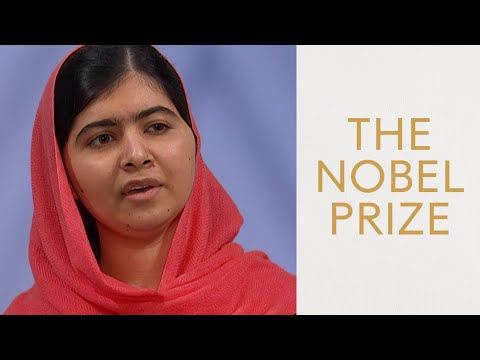
Malala Yousafzai was 17 when she won the 2014 Peace Prize, the youngest laureate ever; Nadia Murad (2018) and Lawrence Bragg (1915) were both 25, as of November 2026. This ranks individual laureates by age on the day their prize was announced. For the countries behind the medals see Most Nobel Prizes by Country.
Pictured: Malala Yousafzai, #1 at 17 years, in the thumbnail of her Nobel Peace Prize Lecture.
Rank
Laureate
Age at award (years)
Age in days
Prize
Year
Country
Born
Prize motivation (summary)
1
Malala Yousafzai
17
6,299
Peace
2014
Pakistan
1997
For her struggle against the suppression of children and young people and for the right of all children to education
2
Nadia Murad
25
9,340
Peace
2018
Iraq
1993
For efforts to end the use of sexual violence as a weapon of war and armed conflict (shared with Denis Mukwege)
2
Lawrence Bragg
25
9,356
Physics
1915
United Kingdom
1890
For services in the analysis of crystal structure by means of X-rays (shared with his father, William Henry Bragg)
4
Tsung-Dao Lee
30
11,299
Physics
1957
China
1926
For work on the parity laws in weak interactions (shared with Chen Ning Yang)
5
Carl Anderson
31
11,393
Physics
1936
United States
1905
For the discovery of the positron (shared with Victor Hess)
5
Paul Dirac
31
11,416
Physics
1933
United Kingdom
1902
For the discovery of new productive forms of atomic theory (shared with Erwin Schrödinger)
5
Werner Heisenberg
31
11,662
Physics
1932
Germany
1901
For the creation of quantum mechanics
5
Frederick Banting
31
11,667
Physiology or Medicine
1923
Canada
1891
For the discovery of insulin (shared with John Macleod)
9
Tawakkol Karman
32
11,930
Peace
2011
Yemen
1979
For the non-violent struggle for the safety of women and for women’s rights to full participation in peace-building work (shared with Ellen Johnson Sirleaf and Leymah Gbowee)
9
Rudolf Mössbauer
32
11,963
Physics
1961
Germany
1929
For research on the resonance absorption of gamma radiation and the discovery of the effect that bears his name (shared with Robert Hofstadter)
11
Joshua Lederberg
33
12,213
Physiology or Medicine
1958
United States
1925
For discoveries concerning genetic recombination in bacteria (shared with George Beadle and Edward Tatum)
11
Mairead Corrigan
33
12,310
Peace
1976
United Kingdom
1944
For founding a peace movement to end violence in Northern Ireland (shared with Betty Williams)
11
Rigoberta Menchú
33
12,334
Peace
1992
Guatemala
1959
For her work for social justice and reconciliation based on respect for the rights of indigenous peoples
11
Brian Josephson
33
12,346
Physics
1973
United Kingdom
1940
For theoretical predictions of the properties of a supercurrent through a tunnel barrier (shared with Leo Esaki and Ivar Giaever)
15
Donald Glaser
34
12,462
Physics
1960
United States
1926
For the invention of the bubble chamber
15
Betty Williams
34
12,560
Peace
1976
United Kingdom
1943
For founding a peace movement to end violence in Northern Ireland (shared with Mairead Corrigan)
15
James Watson
34
12,613
Physiology or Medicine
1962
United States
1928
For discoveries on the molecular structure of nucleic acids (shared with Francis Crick and Maurice Wilkins)
18
Chen Ning Yang
35
12,823
Physics
1957
China
1922
For work on the parity laws in weak interactions (shared with Tsung-Dao Lee)
18
Arthur Compton
35
12,843
Physics
1927
United States
1892
For the discovery of the effect named after him (shared with C.T.R. Wilson)
18
Guglielmo Marconi
35
12,981
Physics
1909
Italy
1874
For contributions to the development of wireless telegraphy (shared with Karl Ferdinand Braun)
18
Frédéric Joliot-Curie
35
13,023
Chemistry
1935
France
1900
For the synthesis of new radioactive elements (shared with Irène Joliot-Curie)
18
Martin Luther King Jr.
35
13,056
Peace
1964
United States
1929
For combating racial inequality through nonviolent resistance
No matching rows.
Age is in completed years on the day the prize was announced, as of November 2026. It is worked out from the birth date and award date of every laureate in the Nobel Foundation’s public laureate data (all 1,000-plus people and organisations), so the list is complete through age 35: nobody else was under 36 on announcement day.[1] A laureate whose recorded birth date lacks a month and day is at least 39 and cannot affect the list. NobelPrize.org and some other lists count age at the December ceremony instead, which gives Lee 31 and Banting 32.[12] Age in days is exact. Rules: only individual people are counted, so organisations are excluded; each person appears once; laureates of the same age in years share a rank and are listed by age in days. Year is the year the prize is named for: the 1932 Physics Prize (Heisenberg) and the 1976 Peace Prize (Corrigan and Williams) were announced a year later. Country is the laureate’s at the time (China means the Republic of China for Lee and Yang). Born is the birth year. For a count by country, see Most Nobel Prizes by Country.
The Top 10
#1
Malala Yousafzai — 17 years
Born on 12 July 1997, Malala Yousafzai was 17 when the 2014 Peace Prize was announced on 10 October 2014, the youngest laureate in any category.[1][2] The Nobel Committee cited her struggle for the right of all children to education; she shared the prize with Kailash Satyarthi. The video is her Nobel Lecture.
#2
Nadia Murad — 25 years
Nadia Murad was 25 when the 2018 Peace Prize was announced on 5 October 2018, shared with Denis Mukwege for efforts to end sexual violence as a weapon of war.[1][3] Wikipedia gives her birth date as 10 March 1993, taken from her own social media, so she is placed by completed years only. The video is her Nobel Lecture.
#2
Lawrence Bragg — 25 years
Born on 31 March 1890, Lawrence Bragg was 25 when he shared the 1915 Physics Prize with his father, William Henry Bragg, for analysing crystal structure with X-rays.[1][4] NobelPrize.org lists him as the youngest Physics laureate to date. The video covers the father-and-son work.
#4
Tsung-Dao Lee — 30 years
Born on 24 November 1926, Tsung-Dao Lee was 30 when the 1957 Physics Prize, shared with Chen Ning Yang, was announced on 31 October 1957, and turned 31 before the December ceremony.[5] That is why some lists give 31: this table counts age on announcement day. The video summarises his Nobel Lecture on parity in weak interactions.
#5
Carl Anderson — 31 years
Born on 3 September 1905, Carl Anderson shared the 1936 Physics Prize with Victor Hess for discovering the positron, the first antimatter particle seen in a cloud chamber.[7] The video is an excerpt from an oral history held by the Niels Bohr Library & Archives.
#5
Paul Dirac — 31 years
Born on 8 August 1902, Paul Dirac shared the 1933 Physics Prize with Erwin Schrödinger for new productive forms of atomic theory.[6] His equation for the electron also predicted antimatter. The video is a documentary on his life, not a Nobel recording.
#5
Werner Heisenberg — 31 years
Born on 5 December 1901, Werner Heisenberg received the Physics Prize for 1932 for the creation of quantum mechanics.[8] The prize was announced in November 1933 after being held over, so he was 31 at the time. The video is a short note on that prize.
#5
Frederick Banting — 31 years
Born on 14 November 1891, Frederick Banting shared the 1923 Medicine Prize with John Macleod for the discovery of insulin.[9] The Karolinska Institute's citation is dated 25 October 1923, and he turned 32 the following month. He remains the youngest laureate in Physiology or Medicine. The video tells the discovery story.
#9
Tawakkol Karman — 32 years
Born on 7 February 1979, Tawakkol Karman was 32 when the 2011 Peace Prize was announced on 7 October 2011.[10] She shared it with Ellen Johnson Sirleaf and Leymah Gbowee for their non-violent struggle for the safety of women and women's rights in peace-building. The video is her ceremony speech.
#9
Rudolf Mössbauer — 32 years
Born on 31 January 1929, Rudolf Mössbauer shared the 1961 Physics Prize with Robert Hofstadter for the effect that bears his name, recoil-free absorption of gamma rays.[11] No verified official video was available, so an icon is shown.
Nobel Foundation, NobelPrize.org API v2.1, laureates (birth dates, award dates and prize motivations for every laureate, accessed November 2026), and the Nobel Prize facts pages (Malala Yousafzai as youngest laureate at 17; Lawrence Bragg as youngest Physics laureate at 25) — api.nobelprize.org, nobelprize.org.
Famous Scientists, “The 11 youngest Nobel Prize winners (scientists)” (cross-check of ages; its convention differs) — famousscientists.org. Birth dates for the other rows are from each laureate’s Wikipedia biography.
YouTube: Nobel Prize and other channels as titled in each entry.