#1
Saltwater Crocodile — 3,700 PSI
The saltwater crocodile holds the highest bite force ever directly measured in a living animal. Its jaw muscles are built for clamping down on prey and holding on, not for chewing.[1]
From crocodiles to hyenas, we measured bite force in pounds per square inch to crown the most powerful jaws in the animal kingdom.
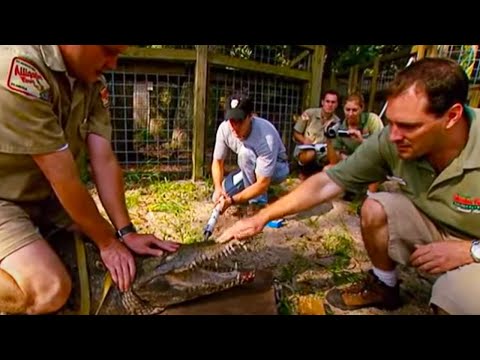
Pictured: the saltwater crocodile, #1 with a 3,700 PSI bite.
| Rank | Animal | Bite force | Class |
|---|---|---|---|
| 1 | Saltwater Crocodile | 3,700 PSI | Reptile |
| 2 | American Alligator | 2,125 PSI | Reptile |
| 3 | Hippopotamus | 1,825 PSI | Mammal |
| 4 | Jaguar | 1,500 PSI | Mammal |
| 5 | Gorilla | 1,300 PSI | Mammal |
| 6 | Grizzly Bear | 1,160 PSI | Mammal |
| 7 | Spotted Hyena | 1,100 PSI | Mammal |
| 8 | Tiger | 1,050 PSI | Mammal |
| 9 | Lion | 650 PSI | Mammal |
| 10 | Bull Shark | 600 PSI | Fish |
No matching rows.
The saltwater crocodile holds the highest bite force ever directly measured in a living animal. Its jaw muscles are built for clamping down on prey and holding on, not for chewing.[1]
Alligators generate almost all of their bite force from a few powerful closing muscles. The muscles that open the jaw, by contrast, are weak enough to hold shut with a hand — a fact wildlife handlers rely on.[1]
Despite a mostly plant-based diet, hippos can open their mouths nearly 180 degrees and deliver a bite strong enough to bend a canoe paddle. Its curved lower canine teeth, often called tusks, grow continuously throughout its life and can reach up to 50 cm long, evolved for fighting rather than chewing plants.[2]
Jaguars typically kill by biting directly through the skull of their prey — a hunting method almost unique among big cats, most of which target the throat. Its name is widely traced to an indigenous South American word often translated as "he who kills with one leap," though some linguists argue it instead derives from a Tupi term simply meaning "large carnivore."[2]
A gorilla's bite is powered by huge jaw muscles anchored to a bony ridge on top of the skull — visible as a pronounced crest in mature males. Most gorillas studied for bite strength are western lowland gorillas, one of two gorilla species, both classified as critically endangered due to poaching, disease, and habitat loss.[2]
Despite a diet that's mostly berries, roots, and fish, a grizzly's jaw muscles are powerful enough to crush a moose's skull in a single bite — kept sharp less for daily foraging than for winning fights over carcasses and mates. Its scientific subspecies name, Ursus arctos horribilis, reflects the dread early naturalists felt facing one, even though grizzlies can also sprint up to 56 km/h (35 mph) over short distances.[2]
Pound for pound, hyenas have one of the strongest bites relative to body size of any land mammal, letting a clan crack open the femurs and skulls that lions and leopards leave behind. Spotted hyena clans are unusually matriarchal — females, who carry higher testosterone levels and outrank every male regardless of size, lead hunts and eat first.[2]
The largest of the big cats delivers a bite strong enough to sever the spinal cord of prey many times its own size, typically aimed at the back of the neck or the throat. The largest subspecies, the Siberian (Amur) tiger, can weigh over 300 kg and was down to fewer than 50 individuals in the wild by the 1940s before conservation efforts helped it recover to roughly 500 today.[2]
Lions hunt cooperatively, so their individual bite doesn't need to be as strong as a solitary predator's — pride mates help wrestle prey down before the fatal bite is delivered. A lion's roar can carry up to 8 km under favorable conditions and register around 114 decibels up close, signaling strength to rival prides without a fight.[2]
Relative to its size, the bull shark's bite is among the strongest of any shark species — one factor in why it's involved in more confirmed unprovoked attacks on humans than most other sharks. Uniquely among sharks, its kidneys let it tolerate freshwater, and bull sharks have been documented more than 1,700 km up the Mississippi River, as far north as Illinois.[2]