Geography & Countries
The Tallest Mountains in the World
Every one of Earth's fourteen peaks above 8,000 metres sits in just two neighboring ranges, the Himalaya and the Karakoram — ranked here by elevation above sea level, not sheer bulk or climbing difficulty.
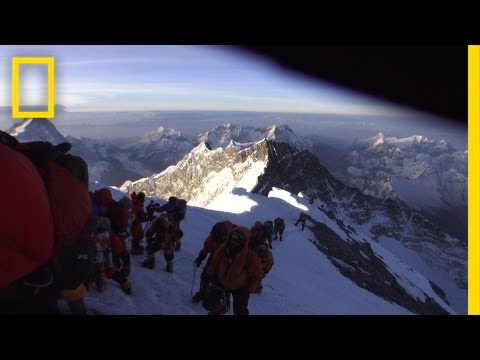
Pictured: Mount Everest, #1 at 8,849 m.
The Top 10
#1
Everest — 8,849 m
Straddling the Nepal–China border, Everest's official height was last revised in 2020 by a joint Chinese–Nepali survey team, which added several metres to the figure long used before it. It was first summited on 29 May 1953 by Edmund Hillary of New Zealand and Tenzing Norgay, a Sherpa climber from Nepal, via the Southeast Ridge, capping three decades of failed British attempts.[1]
#2
K2 — 8,611 m
Known as the "Savage Mountain" for its brutally high fatality-to-summit ratio, K2 wasn't first climbed until 1954 — decades after Everest — and wasn't summited in winter until 2021. That reputation was cemented in August 2008, when a collapsing ice serac swept away fixed ropes above the Bottleneck and left 11 climbers dead over a single weekend, the deadliest disaster in the mountain's climbing history.[2]
#3
Kangchenjunga — 8,586 m
Its name translates roughly to "Five Treasures of the Snows," after its five main summits. Considered sacred by local communities, the 1955 first-ascent team famously stopped just short of the true summit out of respect.[3]
#4
Lhotse — 8,516 m
Lhotse shares its lower flanks with Everest, connected to it by the South Col, and climbers on both mountains cross the same notorious Lhotse Face on their way up. It was first climbed on 18 May 1956 by Swiss mountaineers Ernst Reiss and Fritz Luchsinger, whose oxygen apparatus froze partway up the final couloir and cost them an hour of repairs in the cold before they reached the top.[4]
#5
Makalu — 8,485 m
An isolated, four-sided pyramid of rock and ice east of Everest, Makalu is widely considered one of the most technically demanding 8,000-metre peaks to climb, despite not being one of the tallest. Its first ascent came in 1955, when a nine-member French expedition led by Jean Franco put every single climber on the summit over three days, an outcome almost unheard of on an 8,000-metre peak at the time.[5]
#6
Cho Oyu — 8,188 m
Its name means "Turquoise Goddess" in Tibetan, and Cho Oyu is generally regarded as the most approachable of the fourteen 8,000-metre peaks to climb, thanks to a relatively gentle standard route up its northwest ridge. It was first climbed on 19 October 1954 by a small, low-budget Austrian party — Herbert Tichy, Josef Jöchler, and Sherpa Pasang Dawa Lama — who reached the top without supplemental oxygen, the highest peak climbed that way until Everest itself in 1978.[6]
#7
Dhaulagiri I — 8,167 m
Sanskrit for "White Mountain," Dhaulagiri was briefly thought to be the tallest mountain on Earth after early 19th-century surveys, a title it held until better measurements dethroned it decades later. Its first ascent in 1960 leaned on an unusual tool for the era: a Swiss-piloted Pilatus Porter aircraft, nicknamed the Yeti, that ferried climbers and supplies onto the glacier and still holds the record for the highest landing ever made by a single-engine plane.[7]
#8
Manaslu — 8,163 m
First climbed by a Japanese expedition in 1956, Manaslu's name translates to "Mountain of the Spirit"; for decades many climbers unknowingly stopped short of its true summit, a discrepancy only widely confirmed in recent years. A year before that success, a 1953 Japanese reconnaissance had ended in open conflict with villagers at Samagaon, who blamed the expedition's presence for an avalanche that destroyed their monastery and killed 18 people.[8]
#9
Nanga Parbat — 8,126 m
Nicknamed the "Killer Mountain" after claiming 31 lives across early expeditions before it was finally summited, Nanga Parbat was first climbed solo and without supplemental oxygen by Hermann Buhl in 1953. It claimed another life in 1970, when Reinhold Messner's brother Günther vanished during their descent of the Diamir Face — a mystery not resolved until 2005, when DNA testing confirmed a boot and foot found on the mountain were his.[9]
#10
Annapurna I — 8,091 m
The first 8,000-metre peak ever climbed, summited by a French expedition in 1950 — yet despite that head start, Annapurna still has one of the highest fatality-to-summit ratios of any eight-thousander due to relentless avalanche danger on its south face. The triumph came at a brutal cost: Maurice Herzog lost all his fingers and toes to frostbite on the descent, and Louis Lachenal lost all of his toes, in one of mountaineering's most harrowing survival stories.[10]
Sources
- China–Nepal joint 2020 survey of Mount Everest's elevation, general eight-thousander elevation data, and 1953 first-ascent history, aggregated from national survey and mountaineering-record sources.
- K2 climbing history, first-ascent/first-winter-ascent records, and the 2008 K2 disaster, aggregated from mountaineering historical sources.
- Kangchenjunga first-ascent history and cultural background, aggregated from mountaineering historical sources.
- Lhotse route, geography, and first-ascent history, aggregated from mountaineering reference sources.
- Makalu route, geography, and first-ascent history, aggregated from mountaineering reference sources.
- Cho Oyu route, naming background, and first-ascent history, aggregated from mountaineering reference sources.
- Dhaulagiri elevation-history, naming background, and first-ascent history, aggregated from mountaineering historical sources.
- Manaslu first-ascent history, true-summit background, and the 1953 Samagaon incident, aggregated from mountaineering historical sources.
- Nanga Parbat first-ascent history and the 1970 Messner brothers tragedy, aggregated from mountaineering historical sources.
- Annapurna I first-ascent history, fatality-rate data, and the 1950 descent's frostbite toll, aggregated from mountaineering historical sources.