Science & Space
The Strongest Atlantic Hurricanes on Record
Atlantic hurricanes ranked by lowest minimum central pressure, from the National Hurricane Center’s records, as of October 9, 2026. Wilma’s 882 millibars in 2005 is the record, and the whole list is made up of Category 5 storms.
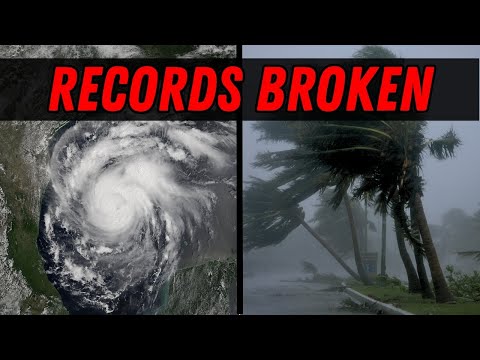
Pictured: the “Hurricane Wilma: The Strongest Atlantic Storm Ever Recorded” video, for Wilma, #1 with an 882 mb minimum pressure.
As of October 9, 2026; the Atlantic season runs through November 30, 2026, so this list could change. Storms are ranked by lowest minimum central pressure in millibars (equal to hectopascals); a lower number is a stronger storm, and storms with the same pressure share a rank, listed oldest first. The values come from the National Hurricane Center’s HURDAT2 best-track database and its post-storm reports, which are revised as old records are reanalyzed: the 1924 Cuba hurricane was upgraded to Category 5 in a 2009 reanalysis, and Camille’s landfall pressure was lowered to 900 mb after a 909 mb reading was found to be outside the eye. Pressures from before aircraft reconnaissance (1944) and satellites are estimates or single land-station readings, and the winds listed are the 1-minute sustained peak, with knots in brackets, which sources round slightly differently (Irma and Milton are quoted at 178–185 mph in different places). The table is trimmed to 17 storms, down to 914 mb; Isabel (2003, about 915 mb), Opal (1995) and Hugo (1989) fall just outside, and their values differ by source. Janet’s 914 mb comes from a barometer reading in Chetumal and is best read as an upper bound. 2026 season: as of October 7 no 2026 storm had become a hurricane, and none is near this list. “Region of peak” is where the minimum pressure occurred, not where the storm made landfall.[1]
The Top 10
#1
Wilma — 882 mb
Wilma holds the Atlantic record at 882 mb, reached on October 19, 2005. A dropsonde measured 884 mb but missed the exact center of the eye, so the National Hurricane Center assessed 882 mb, with peak winds of 185 mph.[2] It made landfall on Cozumel on October 21 with 150 mph winds and later crossed south Florida, where at least six direct deaths and power loss to about 3.5 million customers were reported.[2] The name Wilma was retired.[1]
#2
Gilbert — 888 mb
Gilbert held the Atlantic pressure record for 17 years. Its central pressure fell 74 mb in 24 hours, from 962 mb to 888 mb, and an aircraft measured 185 mph winds.[3] It crossed Jamaica as a Category 3 hurricane with 125 mph winds, then struck the Yucatan Peninsula as a Category 5 on September 14, 1988; the National Hurricane Center counts 319 deaths over 11 days.[3] The name Gilbert was retired.[1]
#3
“Labor Day” hurricane — 892 mb
The Labor Day hurricane struck the upper Florida Keys on September 2, 1935 and holds the lowest pressure ever measured in a landfalling U.S. hurricane: 892 mb, read during the eye passage, from which maximum winds of about 185 mph have been estimated.[4] Many of the dead were World War I veterans working on the Overseas Highway. Estimates of the death toll range from 408 to about 600.[4] It is the strongest documented storm before 1950, and it was never named, since names were not yet in use.[1]
#3 (tie)
Melissa — 892 mb
Melissa ties the 1935 storm at 892 mb, and the National Hurricane Center’s final report raised its peak winds to 190 mph, tying Allen (1980) for the strongest sustained winds of any Atlantic hurricane.[5] It struck southwestern Jamaica near New Hope on October 28, 2025 as a Category 5 with 185 mph winds. Its name was retired in March 2026 and will be replaced by Molly.[5] The newest entry in the list, it moved the 1935 storm down a place in the ranking.
#5
Rita — 895 mb
Rita reached 895 mb and 180 mph on September 21, 2005, making it the most intense hurricane ever recorded in the Gulf of Mexico.[6] It weakened before coming ashore as a Category 3 near the Texas–Louisiana border on September 24 with 115 mph winds. The evacuation ahead of it was one of the largest in U.S. history. The National Weather Service counts 7 direct deaths in the United States, with many more indirect ones.[6]
#5 (tie)
Milton — 895 mb
Milton ties Rita at 895 mb. The National Hurricane Center’s final report puts its peak winds near 180 mph (178 mph), and notes the peak is more uncertain than usual because it fell between Hurricane Hunter flights.[7] It came ashore on Siesta Key, Florida, on October 9, 2024 as a Category 3 with about 115 mph winds, and the report lists 12 direct deaths in Florida, including six killed by an EF-3 tornado.[7] The name Milton was retired in 2025.[1]
#7
Allen — 899 mb
Allen’s 899 mb came with 190 mph winds, still the joint-highest sustained wind speed in the Atlantic with Melissa. Its 1980 measurements are considered less certain than Wilma’s or Gilbert’s, because the instruments of the time could fail in such winds.[8] It reached Category 5 intensity three times, brushed Haiti and Jamaica, and hit south Texas as a Category 3 after about 250,000 people were evacuated.[8] At least 281 people died, and the name Allen was retired.[1]
#8
Camille — 900 mb
Camille came ashore near Waveland, Mississippi, on the night of August 17, 1969 with a revised pressure of 900 mb, after a 909 mb reading was found to be outside the eye.[9] Its 175 mph wind speed is an estimate, since the storm destroyed the wind instruments in the landfall area. A storm surge of about 24 feet and inland flooding in Virginia contributed to 259 deaths.[9] The name Camille was retired.[1]
#9
Katrina — 902 mb
Katrina reached 902 mb and 175 mph over the Gulf of Mexico on August 28, 2005.[10] By landfall near Buras, Louisiana, on August 29 it had weakened to a Category 3 with about 125 mph winds, but it is among the costliest hurricanes on record and the flooding of New Orleans made it one of the most consequential.[10] The name Katrina was retired.[1]
#10
Mitch — 905 mb
Mitch peaked at 905 mb and 180 mph off the northern coast of Honduras in October 1998, but it did its worst damage after weakening, as rain of over 30 inches along the coast and 50 inches inland caused catastrophic flooding and mudslides across Central America.[11] At least 11,374 deaths were confirmed, which makes it the second-deadliest Atlantic hurricane on record behind the Great Hurricane of 1780. The name Mitch was retired.[11]
Sources
- National Hurricane Center / NOAA, HURDAT2 Atlantic best-track database and tropical cyclone reports (pressures and winds); Wikipedia, “Atlantic hurricane” and “List of retired Atlantic hurricane names”; Jonathan Vigh (Colorado State University), “Most Intense Atlantic Hurricanes”; The Weather Channel, “Most Intense Hurricanes On Record In The Atlantic” (2023) and its September 30, 2026 intense-storm ranking; AOML/NOAA 2009 HURDAT reanalysis notes (1921–1925). Rows 11–17 (not written up above) use Wikipedia and NHC reports: Dean (905 mb, 150 kt at its Yucatan landfall), Maria (908 mb, NHC report AL152017), the 1924 Cuba hurricane (910 mb, 165 mph), Ivan (910 mb), Dorian (910 mb, 185 mph), Irma (914 mb, NHC report AL112017) and Janet (914 mb, barometer in Chetumal). 2026 season status from WeatherBug (October 2, 2026) and NHC advisory coverage of Tropical Storm Isaias (October 7, 2026).
- Wikipedia, “Hurricane Wilma” and “Meteorological history of Hurricane Wilma”; NWS Tampa Bay Wilma local summary (south Florida deaths and power loss).
- Hurricane Science, “Hurricane Gilbert”; NHC Gilbert report (NWS NHC 1991-45); NOAA AOML, “30th Anniversary of Hurricane Gilbert”.
- NOAA AOML, “80th Anniversary of the Labor Day Hurricane”; Wikipedia, “1935 Labor Day hurricane”; WeatherWorks and EBSCO summaries (death toll estimates).
- NHC final report on Hurricane Melissa (February 2026) as reported by AOL/Weather Channel and WCTV; WMO, “Hurricane Committee retires name of Melissa, replaces it with Molly” (March 4, 2026); Wikipedia, “Hurricane Melissa” and “2025 Atlantic hurricane season”. The NHC report itself could not be opened from our environment.
- NWS Lake Charles, “Hurricane Rita”; Wikipedia, “Hurricane Rita”.
- NHC tropical cyclone report AL142024 (Milton), as reported by Yahoo News, WPTV and NWS regional summaries; Weather Channel (895 mb tie with Rita).
- Wikipedia, “Hurricane Allen” and “1980 Atlantic hurricane season”; NOAA WPC, “Hurricane Allen” rainfall page.
- NOAA AOML, “45th Anniversary of Hurricane Camille”; NWS Lake Charles, “Hurricane Camille”; Wikipedia, “Hurricane Camille”.
- NWS service assessment, “Hurricane Katrina August 23–31, 2005”; NCEI Storm Events database; Wikipedia, “Hurricane Katrina”.
- Wikipedia and Britannica, “Hurricane Mitch”; NESDIS, “25 Years Later: Looking Back at the October Monster Named Mitch”; hurricanescience.org, “1998: Hurricane Mitch”.
- Video embeds were each found by a youtube.com-restricted search and matched to their storm by title; they are not all from official channels. Wilma, Katrina and Milton are general uploads (uploader channels not confirmed), the Gilbert clip is an archival Jamaica Broadcasting Corporation upload, the Rita clip is a Weather Channel coverage clip, the Allen clip is an infrared satellite animation, the Camille clip is a news-archive upload, the Mitch clip is CNN archive footage, and Melissa and the Labor Day clip are news-station uploads. Public availability was inferred from the search results and not tested by playing each video.