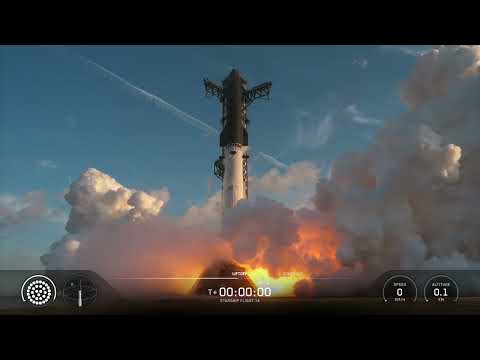
Every orbital-class rocket that has flown at least once, ranked by sea-level liftoff thrust, as of October 5, 2026. SpaceX’s Starship V3 leads at 80,800 kilonewtons, nearly double the Soviet N1 and well above NASA’s Saturn V and SLS.
Pictured: the “FULL MISSION! SpaceX Starship Flight 14” video, for Starship, #1 with 80,800 kN of liftoff thrust.
Rank
Rocket
Liftoff thrust (kN)
Thrust (lbf)
First flight
Operator
Status
Country
Outcome / note
1
Starship / Super Heavy (V3)
80,800
18,160,000
2023
SpaceX
Active
United States
Test flights; first orbital flight Sep 28, 2026
2
N1
45,400
10,200,000
1969
Soviet space program
Retired
Soviet Union
All four flights failed (1969–72)
3
SLS Block 1
39,100
8,800,000
2022
NASA
Active
United States
Flew Artemis I (2022) and II (2026)
4
Energia
35,832
8,055,000
1987
Soviet space program
Retired
Soviet Union
Two flights (1987, 1988)
5
Saturn V
34,500
7,760,000
1967
NASA
Retired
United States
13 launches, no payload lost
6
Space Shuttle
30,160
6,780,000
1981
NASA
Retired
United States
Flew 1981–2011
7
Falcon Heavy
22,819
5,130,000
2018
SpaceX
Active
United States
14 flights as of Oct 1, 2026
8
New Glenn
17,219
3,870,000
2025
Blue Origin
Active
United States
Pre-upgrade thrust; upgrades under way
9
Ariane 64
15,400
3,460,000
2026
Arianespace / ESA
Active
Europe
Ariane 6 with four boosters
10
Ariane 5 ECA
15,120
3,400,000
2002
Arianespace / ESA
Retired
Europe
Last Ariane 5 flight Jul 5, 2023
11
Titan IVB
15,000
3,370,000
1997
US Air Force / Lockheed Martin
Retired
United States
Last flight Oct 19, 2005
12
Vulcan Centaur (VC4S)
13,000
2,920,000
2024
United Launch Alliance
Active
United States
Largest flown version; VC6 not yet flown
13
Atlas V 551
12,141
2,730,000
2006
United Launch Alliance
Active
United States
Satellite launches ended Jul 2026
14
Long March 5
10,680
2,400,000
2016
CASC / CALT
Active
China
18 launches, 1 failure
15
Proton-M
10,532
2,368,000
2001
Khrunichev / Roscosmos
Active
Russia
Proton family has flown since 1965
No matching rows.
As of October 5, 2026. Thrust is the manufacturer- or agency-published sea-level thrust at liftoff, in kilonewtons, with pounds-force converted from it (1 kN is about 224.8 lbf); values are nominal design figures, not measured, and sources differ by a few percent. Inclusion rule: a rocket must have launched at least once, one row per vehicle at its most powerful version that has actually flown. That puts the N1 in despite all four flights failing, and leaves out designs that have never flown, such as Long March 9, Long March 10A, SLS Block 1B, Vulcan VC6 and the 9×4 New Glenn. The table is trimmed to the top 15, so Delta IV Heavy (9,341 kN) and smaller rockets fall just outside. Figures still evolving: Starship’s number is the V3 rating (Flights 12–14 in 2026; earlier versions were lower), and New Glenn’s is its pre-upgrade rating. “Active” for Atlas V means it has stopped launching satellites (July 2026) but still has Starliner flights booked, and Vulcan is flying but has had national-security missions paused after a booster anomaly in February 2026.[1]
The Top 10
#1
Starship / Super Heavy (V3) — 80,800 kN
Version 3 of the 33-engine Super Heavy booster, with Raptor 3 engines, is rated at about 80,800 kN (more than 18 million pounds-force) at liftoff, well over the 33,700 to 35,000 kN of the Saturn V.[2] V3 debuted on Flight 12 on May 22, 2026, and Flight 14 on September 28, 2026 was Starship’s first orbital flight, deploying 26 Starlink V3 satellites even after one booster engine and one ship engine shut down early.[2][3]
#2
N1 — 45,400 kN
The Soviet Moon rocket’s first stage burned 30 NK-15 engines at once for 45,400 kN, the most powerful rocket stage ever flown, and N1 sits here because it did launch, four times between 1969 and 1972.[4] All four flights failed, and the second one crashed back onto its pad in one of the largest non-nuclear explosions in history.[4]
#3
SLS Block 1 — 39,100 kN
NASA puts the Block 1 SLS at 8.8 million pounds-force (about 39 MN) from four RS-25 engines and two five-segment solid boosters, about 15% more than the Saturn V.[5] It flew uncrewed on Artemis I in 2022 and carried four astronauts around the Moon on Artemis II, launching April 1, 2026.[5]
#4
Energia — 35,832 kN
Four RD-170 kerosene boosters and a hydrogen core with four RD-0120 engines gave the Soviet heavy-lifter about 35,832 kN at liftoff.[6] It flew twice, with the Polyus military platform in 1987 and the uncrewed Buran shuttle on November 15, 1988, before the programme was discontinued.[6] The figure is an astronautix.com value, and published numbers for Energia vary by a few percent.
#5
Saturn V — 34,500 kN
Five F-1 engines produced about 34.5 MN (roughly 7.6 million pounds-force) at liftoff according to NASA-sourced figures, though some references quote up to 35,100 kN.[7] Thirteen Saturn Vs flew between November 9, 1967 and May 14, 1973, and it stayed the most powerful rocket to reach orbit until Starship.[7]
#6
Space Shuttle — 30,160 kN
The orbiter’s three main engines and two solid boosters produced a total liftoff thrust of about 30.16 MN, or 6.78 million pounds-force, with the boosters supplying most of it.[8] It flew from 1981 to its final launch, Atlantis on STS-135, on July 8, 2011.[8]
#7
Falcon Heavy — 22,819 kN
Three Falcon 9 cores with 27 Merlin engines deliver about 22,819 kN (5.13 million pounds-force), the most powerful operational rocket until SLS flew.[9] NROL-97 on October 1, 2026 was its 14th flight and the first for the U.S. National Reconnaissance Office, following ViaSat-3 and the Roman Space Telescope earlier this year.[9]
#8
New Glenn — 17,219 kN
Blue Origin’s seven BE-4 engines provide about 3.9 million pounds-force (17,219 kN) at liftoff, a figure Blue Origin plans to lift to roughly 19,900 kN with upgraded engines.[10] Its third flight, on April 19, 2026, was the first to reuse a booster, which landed at sea, though the payload ended up in the wrong orbit.[10]
#9
Ariane 64 — 15,400 kN
Europe’s Ariane 6 with four solid boosters is credited with up to 15,400 kN at liftoff.[11] Flight VA269 on June 17, 2026 flew the first Ariane 64 with upgraded P160C-based boosters and carried 36 Amazon Leo satellites, the heaviest payload an Ariane has launched.[11] The listed thrust was published for the P120C boosters, so the newer boosters may add a little.
#10
Ariane 5 ECA — 15,120 kN
Two large solid boosters plus a Vulcain 2 core gave Europe’s previous workhorse about 15,120 kN.[12] Ariane 5 retired after 117 flights, the last being VA261 on July 5, 2023 with Heinrich Hertz and Syracuse-4B.[12]
Wikipedia rocket pages, as surfaced by search summaries (the pages themselves could not be opened from our build environment); Spaceflight Now, Space Force/ULA and Wikipedia coverage of the Vulcan booster anomaly (February 12, 2026); Rolling Out and Wikipedia, “Atlas V” (satellite launches ended July 2, 2026, six Starliner rockets remain); Wikipedia, “Long March 9” and “Long March 10” (not yet flown).
Wikipedia, “SpaceX Starship” and “SpaceX Super Heavy” (V3 liftoff thrust of 80,800 kN); Space.com (33 engines, over 18 million pounds-force at liftoff); SpaceX, Starship Flight 12 and 13 pages and Next Spaceflight (Flight 12, May 22, 2026; Flight 13, July 24, 2026).
SpaceX, Starship Flight 14 page; CNN, New Atlas, Space.com and New Space Economy (September 28, 2026, 26 Starlink V3 satellites, booster and ship engine shutdowns).
Wikipedia, “N1 (rocket)”; Astronautix, “N1” (45,400 kN, 30 NK-15 engines); New Space Economy and Amusing Planet (four failed launches, 1969–72).
NASA, Space Launch System and Artemis II pages; Boeing, “Artemis II moon rocket launches historic mission” (April 2026); NASA technical paper “Artemis I Results and the Path Forward” (8.8 million pounds-force, about 39 MN).
Astronautix, “Energia” and Wikipedia, “Energia (rocket)” (35,832 kN; Polyus 1987 and Buran 1988 flights); Wikipedia, “RD-170”.
Smithsonian National Air and Space Museum, “F-1 engine” (34.5 MN, 7.6 million pounds-force); NASA, “55 Years Ago: Apollo 4, the First Flight of the Saturn V”; Astronautix, “Saturn V” (13 launches, November 9, 1967 to May 14, 1973); Wikipedia and Spaceline (higher 35,100 kN figure).
NASA, “The Space Shuttle” and spaceflight.nasa.gov Shuttle basics; ESA, “Shuttle technical facts” (6.781 million pounds-force, 30.16 MN); NASA, “STS-135: Final Launch of the Space Shuttle Program” (July 8, 2011).
Wikipedia, “Falcon Heavy” and Wevolver (22,819 kN, 5.13 million pounds-force); KeepTrack, “Falcon Heavy Launch History and Statistics” and X Report of October 2, 2026 (NROL-97, October 1, 2026; ViaSat-3 and Roman missions in 2026).
Wikipedia, “New Glenn” and “List of New Glenn boosters”; NASASpaceFlight, “Blue Origin announce upgrades to New Glenn ahead of Flight 3” and “New Glenn launches on third mission”; Space.com and Spaceflight Now (NG-3, April 19, 2026, first booster reuse, wrong orbit).
ESA, “More boosters, more power: Ariane 6 lifts off with four boosters for the first time” and VA269 coverage (June 17, 2026); Wikipedia, “Ariane 6” (15,400 kN in the A64 configuration).
Wikipedia, “Ariane 5” and “Ariane flight VA261”; CNES, “Ariane 5”; Spaceflight Now, “Europe’s workhorse Ariane 5 rocket to retire after 27 years service” (15,120 kN; 117 flights).
Rows 11–15 (not written up above): Titan IVB, Wikipedia and Spaceline fact sheet (about 15,000 kN, last flight October 19, 2005; Cassini, October 15, 1997); Vulcan Centaur VC4S, Wikipedia and Gunter’s Space Page (two BE-4 at 2,400 kN plus four GEM 63XL, about 13,000 kN; first flight 2024); Atlas V 551, Wikipedia and Astronautix (12,141 kN); Long March 5, Wikipedia and Spaceflight Now (about 10,680 kN; first flight November 3, 2016); Proton-M, Wikipedia (10,532 kN first-stage thrust; first flight April 7, 2001).
Video embeds were each confirmed to be public and to match their rocket: SpaceX Starship Flight 14 full-mission video (an uploader other than SpaceX’s own channel could not be ruled out), NASA’s Artemis II recap, an archive upload of the Energia-Buran launch, the original NASA Apollo 11 launch video, NASA’s STS-135 launch, SpaceX’s Falcon Heavy first launch, Blue Origin’s NG-3 coverage and the ESA/Arianespace VA269 launch video. N1 and Ariane 5 keep the icon because no suitable verified video was found.