Science & Space
The Countries with the Most Nobel Prizes
Nobel Prize laureates by country, 1901 through the 2026 announcements, as of October 12, 2026. The United States leads with 429, then the United Kingdom with 144 and Germany with 116.
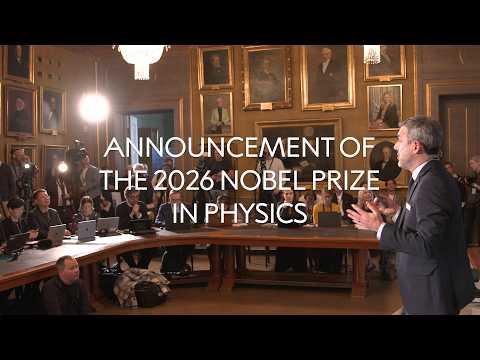
Pictured: the Nobel Prize’s “Announcement of the 2026 Nobel Prize in Physics” video, for Francis Halzen of the University of Wisconsin–Madison, the United States, #1 with 429 laureates.
As of October 12, 2026, through all six 2026 announcements, from Medicine (October 5) to Economic Sciences (October 12). Counting rule: every Nobel Prize and Economic Sciences award, including organisations, counts once per laureate under every country the Nobel Foundation names for them (country of affiliation at the time of the award, plus birth country when it differs); a person awarded twice counts twice (Pauling, Bardeen and Sanger, for example). So a laureate with two countries, such as Francis Halzen (Belgium and the United States) or Marie Curie (Poland and France), is counted for both, and the country totals add up to more than the number of laureates. A pure birth-country count would give different totals, and so would counting only affiliation at the time of the award. Sources differ by a few laureates for this reason and for timing.[1] The six category columns add up to each country’s total. Countries with the same total share a rank, and Russia is combined with the Soviet Union. Inclusion rule: the 15 countries with 15 or more laureates; Norway, Israel and Denmark (14 each) fall just outside. First laureate is the earliest year in the country’s list. Videos are from the official Nobel Prize channel.[4]
The Top 10
#1
United States — 429
The count is led by 118 prizes in Medicine and 107 in Physics, and its 78 in Economics are the widest gap over any other country.[2] Linus Pauling won the Chemistry prize in 1954 and the Peace Prize in 1962, and John Bardeen won Physics twice (1956 and 1972), so both count twice here.[2] The 2026 season added four: Karl Deisseroth (Medicine), Francis Halzen (Physics, Belgian-born and listed under both countries) and Robert Hall and Michael Woodford (Economics).[3]
#2
United Kingdom — 144
The UK is the only country besides the US with more than 100 prizes, with Chemistry and Medicine tied at 37 each.[2] Frederick Sanger won Chemistry twice, in 1958 for the structure of insulin and in 1980 for DNA sequencing, so he counts twice in the 144 shown here.[2] Ronald Ross, born in India, won the 1902 Medicine prize and is the UK’s earliest laureate on this list; Geoffrey Hinton (Physics, 2024) is also listed under Canada.[2]
#3
Germany — 116
Germany’s tally is almost evenly split between Physics (35), Chemistry (35) and Medicine (28), and it includes the very first prizes in 1901, to Wilhelm Conrad Röntgen in Physics and Emil von Behring in Medicine.[2] Albert Einstein’s 1921 Physics prize is listed here too.[2] In 2026 Peter Hegemann (Humboldt University, Berlin) and Georg Nagel (University of Würzburg) shared the Medicine prize with Karl Deisseroth for light-gated ion channels and optogenetics.[3]
#4
France — 79
France is the only country in the top four with more Literature prizes (17) than Chemistry or Medicine, beginning with Sully Prudhomme in 1901, the first Literature laureate.[2] Marie Curie, born in Poland, won Physics in 1903 and Chemistry in 1911 and is listed under both France and Poland.[2] Henri Kagan, an emeritus professor in Orsay, France, shared the 2026 Chemistry prize with Japan’s Kenso Soai.[3]
#5 (tie)
Sweden — 34
Sweden’s 34 are spread across all six prizes, with Medicine (9) and Literature (8) the strongest.[2] Svante Arrhenius won Chemistry in 1903, and Svante Pääbo won Medicine in 2022.[2] Anne L’Huillier, born in France and working at Lund University, won the 2023 Physics prize and is listed under both countries.[2]
#5 (tie)
Japan — 34
Asia’s leader on this list won its first prize in 1949, when Hideki Yukawa received Physics, and its mix leans to science: 12 in Physics and 11 in Chemistry, with none in Economics.[2] Takaaki Kajita won Physics in 2015 for neutrino oscillations.[2] The 2026 Chemistry prize went partly to Kenso Soai, a professor emeritus at Tokyo University of Science, for autocatalysis in asymmetric synthesis.[3]
#7 (tie)
Russia / Soviet Union — 30
The list combines Russia and the Soviet Union, and Physics leads with 12 prizes.[2] Ivan Pavlov won Medicine in 1904, the country’s earliest entry; Mikhail Gorbachev won Peace in 1990 and journalist Dmitry Muratov in 2021.[2] Laureates born in the region but working abroad count here only if the Nobel Foundation names Russia for them.
#7 (tie)
Canada — 30
Canada’s first laureate was Frederick Banting, who won Medicine in 1923.[2] Its most recent is poet Anne Carson, born in Toronto and announced as the 2026 Literature laureate on October 8, 2026; she has also held Icelandic citizenship since 2022.[3] Several Canadian-affiliated laureates were born elsewhere, and Hinton (born in the UK) appears in both the Canadian and British lists.[2]
#9
Switzerland — 27
Switzerland’s tally spans Medicine (8), Physics (7) and Chemistry (7), and starts in 1901 with Henry Dunant’s Peace Prize.[2] Jacques Dubochet won Chemistry in 2017 for cryo-electron microscopy.[2]
#10
Austria — 25
Medicine is Austria’s strongest field at 9 prizes.[2] Bertha von Suttner won the Peace Prize in 1905, and Anton Zeilinger shared the 2022 Physics prize for quantum entanglement experiments.[2]
Sources
- Counts are tallied from the per-country laureate lists in Wikipedia, “List of Nobel laureates by country” (page revision of October 12, 2026, which reproduces the countries named on nobelprize.org). The page’s own summary table lags the lists (it shows the US at 427 laureates and 430 prizes, against 426 laureates and 429 prizes in its lists). Earlier tallies: Edzard Ernst, “Some simple, descriptive and revealing statistics on the Nobel Prize” (October 2025: US 424, UK 144, Germany 116, France 77) and Adda247 (2025: US 423, UK 143, Germany 115, France 76); sources differ by one to three because of when they counted and how they treat laureates named under two countries.
- Wikipedia, “List of Nobel laureates by country”, individual country sections (Pauling, Bardeen, Sanger, Curie, Ross, Röntgen, Behring, Yukawa, Kajita, Pavlov, Gorbachev, Muratov, Banting, Dubochet, Suttner, Zeilinger, Arrhenius, Pääbo, L’Huillier); the lists are edited continually.
- 2026 laureates: Medicine, Physics, Chemistry, Literature, Peace and Economic Sciences announcements as reported on nobelprize.org result pages and by Khaleej Times, Al Jazeera, Nippon.com, Newsweek, CNBC, the Japan Times and Forbes (October 5–12, 2026). Medicine: Karl Deisseroth (Stanford), Peter Hegemann (Humboldt University Berlin), Georg Nagel (University of Würzburg). Physics: Francis Halzen (University of Wisconsin–Madison, born in Belgium). Chemistry: Henri B. Kagan (France) and Kenso Soai (Japan). Literature: Anne Carson (Canada). Peace: Navi Pillay (South Africa). Economic Sciences: Robert E. Hall (Stanford) and Michael Woodford (Columbia), announced October 12, 2026.
- Video embeds are all from the official Nobel Prize YouTube channel; each was checked through YouTube’s oEmbed lookup (public, embeddable, uploader “Nobel Prize”, standard-format video). Sweden and Japan entries use interview and lecture videos of a laureate listed under that country; the Canada, Germany and France entries use the 2026 announcement video for a laureate from that country. Switzerland, Austria and Russia use laureate interviews. The Nobel Foundation’s own site could not be opened from our build environment.