Bikes, e-bikes and scooters all need the same thing: a connected network of low-stress lanes and trails. This ranking uses PeopleForBikes' 2026 City Ratings (released June 2026), which score each city from 0 to 100 on how many everyday destinations, like jobs, schools, parks, grocery stores and essential services, residents can reach on safe, low-stress routes. Shown here are the top 10 large cities, those with more than 300,000 residents. New York City's five boroughs are rated separately.
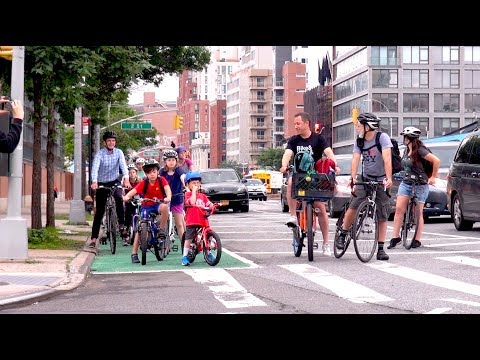
Pictured: families riding Brooklyn’s 4th Avenue protected bike lane. Brooklyn ranks #1 with a score of 70.
Rank
City
State
Score
Region
Population (2020)
1
Brooklyn
New York
70 / 100
Northeast
2,736,074
2
Minneapolis
Minnesota
68 / 100
Midwest
429,954
3
Seattle
Washington
66 / 100
West
737,015
4
Queens
New York
63 / 100
Northeast
2,405,464
5
San Francisco
California
61 / 100
West
873,965
6
Milwaukee
Wisconsin
57 / 100
Midwest
577,222
7
St. Paul
Minnesota
56 / 100
Midwest
311,527
8
Portland
Oregon
55 / 100
West
652,503
9
Detroit
Michigan
55 / 100
Midwest
639,111
10
Philadelphia
Pennsylvania
54 / 100
Northeast
1,603,797
No matching rows.
The Top 10
#1
Brooklyn, New York — 70
Brooklyn has been America's top-rated large city for biking since PeopleForBikes started rating New York's five boroughs separately in 2025. It has more miles of bike lanes than any other borough, and its 25 mph residential speed limit keeps many side streets calm enough for low-stress riding.[1] One of its best-known routes is the two-way protected path along Prospect Park West. When it opened in 2010 it took a travel lane from cars, and weekday bike traffic on the street more than tripled to over 1,000 riders a day.[2]
#2
Minneapolis, Minnesota — 68
Minneapolis was the top-scoring large city before Brooklyn passed it. It has about 89 miles of trails, 36 miles of curb-protected bikeways, 24 miles of bike boulevards and 140 miles of painted bike lanes.[3] Its best-known route is the Midtown Greenway, a 5.5-mile former rail corridor that runs mostly below or above the street grid. It is lit at night, open 24/7, and plowed in winter, so hundreds of riders use it even on snowy days.[4]
#3
Seattle, Washington — 66
Over the last few years Seattle has built a connected protected-lane grid downtown, with routes on 2nd Avenue, 4th Avenue, 7th and 8th Avenues and the rebuilt Alaskan Way waterfront. The 4th Avenue protected lane opened in 2021, paid for by the city's transportation levy.[5] In spring 2026 the Seattle Department of Transportation said its newest downtown lane had closed the last gap on its planned "City Center" bike map.[5]
#4
Queens, New York — 63
Queens is the second New York borough in the top five. In May 2025 the Queensboro Bridge's north outer roadway became a bike-only path, and pedestrians moved to their own path on the south side, ending years of crowded shared space between Queens and Manhattan.[6] A two-way, concrete-protected bikeway on Northern Boulevard links riders to the bridge.[6]
#5
San Francisco, California — 61
San Francisco has the steepest hills of any city in the top 10, but it has still built a well-connected network. Private cars were banned from much of Market Street, its main downtown boulevard, in 2020. JFK Drive in Golden Gate Park became a permanent car-free promenade after a 2022 vote.[7]
#6
Milwaukee, Wisconsin — 57
Milwaukee is new to the large-city top 10 this year. It got there after meeting its goal of building 50 miles of protected bikeways by 2026.[1]
#7
St. Paul, Minnesota — 56
Minneapolis's twin city also makes the top 10, so Minnesota is the only state other than New York with two cities on the list. St. Paul is also the smallest city here, just over the 300,000-resident cutoff for the large-city category.[1]
#8
Portland, Oregon — 55
Portland is one of America's best-known bike cities and regularly made PeopleForBikes' top five large cities in earlier editions. Its score fell from 61 in 2025 to 55 in 2026, mostly because of the 2026 methodology changes. Under the new rules, paint-only bike lanes count as low-stress only on streets with speed limits of 20 mph or less.[8]
#9
Detroit, Michigan — 55
Detroit is the other newcomer to the top 10 this year, after expanding its bike network. It ties Portland on score, which is notable for the city that built the American auto industry.[1]
#10
Philadelphia, Pennsylvania — 54
Philadelphia completes the top 10 and is the only city on the list besides Brooklyn and Queens with more than a million residents. Like every city in the top 10, it scores above 50. PeopleForBikes treats 50 as the point where a low-stress network is connected enough for biking to really take off.[1]
PeopleForBikes, "2026's Best Places to Bike" and the 2026 City Ratings summary report (June 2026): large-city (300,000+ residents) top 10 and scores, newcomers to the top 10, and national results (555 cities scoring 50 or higher, up from 234 in 2025). Brooklyn's 2025 #1 finish and its bike-lane mileage and speed-limit details come from PeopleForBikes' 2025 coverage ("America Has a New Best Large City for Biking"). City populations are from the 2020 U.S. Census, the baseline the 2026 ratings use.
NYC Department of Transportation, Prospect Park West bicycle path project page and ridership figures.
City of Minneapolis, Protected Bikeways Program and Minneapolis Street Design Guide (bikeway mileage).
Midtown Greenway Coalition, "About the Greenway."
Seattle Department of Transportation blog posts on the 4th Ave protected bike lane opening (2021) and the downtown "City Center" network (April 2026).
NY1, amNY and QNS reporting on the Queensboro Bridge's separate bike and pedestrian paths (May 2025), and NYC DOT project materials for the Northern Boulevard protected bikeway.
San Francisco Municipal Transportation Agency and news coverage of the car-free Market Street and JFK Promenade changes.
PeopleForBikes, "2026 City Ratings Methodology Updates: What Is Changing and Why It Matters," plus coverage of Portland's 2026 score change.