Operating optical and infrared telescopes, ranked by effective aperture in metres, as of October 10, 2026. The Large Binocular Telescope leads at 11.8 m combined, with the Gran Telescopio Canarias the largest single mirror at 10.4 m.
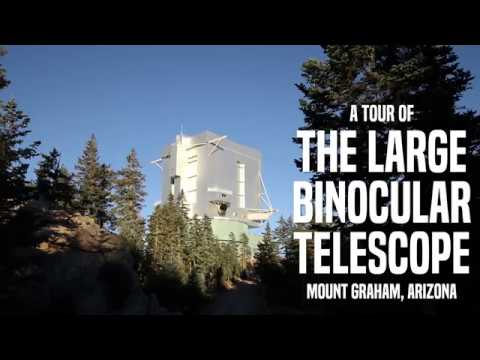
Pictured: the “Touring Arizona’s Giant Observatory” video, for the Large Binocular Telescope, #1 with an 11.8 m equivalent aperture.
Rank
Telescope
Aperture (m)
Country
Site
Altitude (m)
First light
Operator
Type
Note
1
Large Binocular Telescope (two 8.4 m mirrors, combined)
11.8
United States
Mount Graham, Arizona
3,221
2005
LBT Corporation (University of Arizona, INAF, German partners)
Ground
First light 2005 on one mirror; both mirrors together from 2008
2
Gran Telescopio Canarias (GTC)
10.4
Spain
La Palma, Canary Islands
2,267
2007
Instituto de Astrofísica de Canarias
Ground
Largest single-mirror optical telescope; 36 segments
3
Keck I
10.0
United States
Mauna Kea, Hawaii
4,145
1990
W. M. Keck Observatory
Ground
First light with 9 of 36 segments; full mirror in 1993
3
Keck II
10.0
United States
Mauna Kea, Hawaii
4,145
1996
W. M. Keck Observatory
Ground
Twin of Keck I
5
Hobby–Eberly Telescope (HET)
9.2
United States
Davis Mountains, Texas
2,025
1996
McDonald Observatory (UT Austin-led consortium)
Ground
11 m mirror, 9.2 m effective; fixed elevation
5
Southern African Large Telescope (SALT)
9.2
South Africa
Sutherland, Northern Cape
1,798
2005
South African Astronomical Observatory / SALT Foundation
Ground
11.1 × 9.8 m mirror, 9.2 m effective
7
Very Large Telescope (four 8.2 m Unit Telescopes)
8.2
Chile
Cerro Paranal
2,635
1998
European Southern Observatory (ESO)
Ground
Each of the four counts as 8.2 m; Antu first light 1998
7
Subaru Telescope
8.2
United States
Mauna Kea, Hawaii
4,139
1999
NAOJ (Japan)
Ground
Engineering first light Dec 1998; science tests Jan 1999
9
Gemini North
8.1
United States
Mauna Kea, Hawaii
4,213
1999
NOIRLab (International Gemini Observatory)
Ground
Twin of Gemini South
9
Gemini South
8.1
Chile
Cerro Pachón
2,722
2000
NOIRLab (International Gemini Observatory)
Ground
Altitude varies by source (2,722–2,737 m)
11
James Webb Space Telescope
6.5
Space (Sun–Earth L2)
L2 point, 1.5 million km from Earth
n/a (space)
2022
NASA / ESA / CSA
Space
Launched Dec 25, 2021; 18 segments
11
Magellan Baade
6.5
Chile
Las Campanas
2,516
2000
Carnegie Institution (Magellan consortium)
Ground
Twin of Clay
11
Magellan Clay
6.5
Chile
Las Campanas
2,516
2002
Carnegie Institution (Magellan consortium)
Ground
Twin of Baade
11
Vera C. Rubin Observatory (Simonyi Survey Telescope)
6.5
Chile
Cerro Pachón
2,647
2025
NSF–DOE (NOIRLab / SLAC)
Ground
8.4 m mirror, about 6.5 m effective; survey began June 29, 2026
No matching rows.
As of October 10, 2026. Aperture is the effective, single-circular-mirror-equivalent diameter in metres as stated by the operator: the Large Binocular Telescope counts its two 8.4 m mirrors combined (11.8 m), HET and SALT count their effective 9.2 m rather than the full mirror span, and Rubin counts about 6.5 m rather than its 8.4 m mirror. The largest single mirror is the Gran Telescopio Canarias at 10.4 m. Telescopes with the same aperture share a rank, and the four Very Large Telescope units count as one row. Inclusion rule: operating optical or infrared telescopes only, trimmed to 14 rows; radio telescopes and smaller 6 m class instruments such as the MMT and BTA-6 are not listed, and Hubble (2.4 m) falls outside. Altitudes come from Wikipedia and observatory pages and differ by a few metres between sources;[1] first light is the year of the first light on sky, which for Keck I and the GTC used only part of the final mirror. Under construction, not ranked: ESO’s Extremely Large Telescope (39 m) has a telescope first light of March 2029 and scientific first light in December 2030, per ESO’s March 2025 schedule, the latest I could find; the Giant Magellan Telescope is in its final design phase and still needs federal funding; the Thirty Meter Telescope was left out of NSF’s final-design phase in 2025 and has no confirmed schedule.[12]
The Top 10
#1
Large Binocular Telescope — 11.8 m
Two 8.4 m mirrors share one mount on Mount Graham, and together they collect as much light as a single 11.8 m circular mirror.[2] First light came in October 2005 using one mirror, and the first images with both mirrors working together followed in 2008.[2] Used in interferometric mode, its resolution is comparable to a 22.8 m telescope, which is the fun fact that sets it apart from every single-mirror giant.[2]
#2
Gran Telescopio Canarias — 10.4 m
The GTC on La Palma is the largest single-mirror optical telescope, with a 10.4 m primary built from 36 hexagonal segments.[3] It cost about €130 million over seven years of construction; its first-light ceremony in 2007 took place with only 12 of the 36 segments installed, and scientific observations began in 2009.[3]
#3 (tie)
Keck I and Keck II — 10 m
The twin Keck telescopes near the summit of Mauna Kea each have a 10 m mirror of 36 hexagonal segments.[4] Keck I saw first light on November 24, 1990 with just 9 segments, and Keck II followed in 1996; the pair were the largest optical telescopes in the world until 2006 and are now ranked third and fourth by their nominal diameter.[4] Their segmented design became the template for nearly every giant telescope since.[4]
#5 (tie)
Hobby–Eberly Telescope — 9.2 m effective
The HET in West Texas has an 11 m mirror of 91 segments, but because it is fixed at one elevation and the instrument tracks across it, only about 9.2 m is used at a time.[5] It reached first light in December 1996, was dedicated in October 1997 and finished commissioning in October 1999, built far more cheaply than a conventional telescope of its size.[5] Other sources round its aperture to 10 m.
#5 (tie)
Southern African Large Telescope — 9.2 m effective
SALT is a close relative of the HET, with 91 hexagonal segments forming an 11.1 × 9.8 m mirror and a 9.2 m effective aperture.[6] It is permanently tilted 37 degrees from the zenith and turns only in azimuth, and press coverage calls it the largest optical telescope in the Southern Hemisphere.[6] First light was September 1, 2005 at Sutherland, 1,798 m up on the edge of the Kalahari.[6]
#7 (tie)
Very Large Telescope — four 8.2 m units
ESO’s flagship on Cerro Paranal has four 8.2 m Unit Telescopes, named Antu, Kueyen, Melipal and Yepun after Mapuche words for sky objects.[7] Antu saw first light on May 25, 1998, and the telescopes can also be combined as an interferometer to see details up to 25 times finer than any one of them.[7]
#7 (tie)
Subaru Telescope — 8.2 m
Japan’s 8.2 m telescope sits at 4,139 m on Mauna Kea and is run by NAOJ.[8] Engineering first light was on December 24, 1998, test observations followed in January 1999, it was inaugurated in September 1999, and it opened to Japanese and international astronomers from December 2000.[8] The name is the Japanese word for the Pleiades star cluster. No suitable verified video was found, so the icon is used.
#9 (tie)
Gemini North and Gemini South — 8.1 m
The two twin 8.1 m telescopes, on Mauna Kea in Hawaii and Cerro Pachón in Chile, give one observatory a view of both hemispheres.[9] Gemini North saw first light in 1999 and Gemini South in 2000.[9] The video shows Gemini North.
#11 (tie)
James Webb Space Telescope — 6.5 m
Webb’s 6.5 m mirror is 18 gold-plated beryllium segments that unfolded in space, with a collecting area of about 25 square meters, roughly six times Hubble’s.[10] It launched on December 25, 2021 and works near the Sun–Earth L2 point; it is the only space telescope in the table.[10] Counting collecting area rather than the mirror’s widest span, its effective diameter is smaller than 6.5 m.
#11 (tie)
Vera C. Rubin Observatory — 8.4 m mirror, 6.5 m effective
Rubin’s 8.4 m mirror is a single piece combining primary and tertiary surfaces, with about 6.5 m effective aperture once the central part is accounted for, according to a 2026 Rubin paper (a 2024 deck gave 6.7 m).[11] First test observations came in April 2025, the first public images on June 23, 2025, and the 10-year Legacy Survey of Space and Time began on June 29, 2026.[11]
Wikipedia and observatory pages for each telescope as surfaced by search summaries (the pages themselves could not be opened from our build environment); the aperture convention and inclusion rule are ours.
Wikipedia, “Large Binocular Telescope”; AIP Potsdam LBT project page (11.8 m equivalent); PhysOrg and Universe Today on first light and first binocular light (October 12, 2005; March 2008); University of Arizona news (altitude about 3,200 m; Wikipedia and Britannica give 3,221 m).
Wikipedia, “Gran Telescopio Canarias”; Guinness World Records, “Largest single optical telescope” (July 13, 2007); Sky & Telescope (first-light ceremony with 12 segments); Britannica gives the observatory elevation as 2,326 m, most sources 2,267 m.
Wikipedia, “W. M. Keck Observatory”; Astronomy.com, “Nov. 24, 1990: Keck I sees first light”; Britannica, “Keck Observatory”. Keck II’s first-light date varies by source (October 23, 1996 most common; one version says April 27, 1996).
McDonald Observatory, Hobby-Eberly Telescope pages and “Hobby-Eberly Telescope Enters Early Operation Phase” (9.2 m effective, December 1996 first light, 1997 dedication, 1999 commissioning end); UT Austin HET documentation; Orbit Codex for altitude (about 2,025 m; not independently confirmed).
Wikipedia, “Southern African Large Telescope” (9.2 m effective, 11.1 × 9.8 m mirror, 1,798 m); Sky & Telescope, Astronomy.com and Penn State on first light (September 1, 2005).
Wikipedia, “Very Large Telescope”; ESO, “From Antu to Yepun” and Laser Focus World on Antu’s first light (May 25, 1998). Altitude is 2,635 m or 2,636 m depending on source.
Wikipedia, “Subaru Telescope”; Current Performance and On-Going Improvements of the 8.2 m Subaru Telescope (arXiv astro-ph/0405012); Physics World (January 1999). Britannica gives 4,163 m for the summit.
NOIRLab, Gemini North page; Wikipedia, “Gemini Observatory” (4,213 m); Orbit Codex for Gemini South (2,722 m; Gemini’s own site gives 2,737 m).
Wikipedia, “James Webb Space Telescope”; NASA Webb channel and mission pages (December 25, 2021 launch); search coverage of the 18-segment mirror and 25 m² collecting area.
The Vera C. Rubin Observatory Data Preview 1 (arXiv 2603.23786; 6.5 m effective); Rubin status slide deck 2024 (6.7 m); NOIRLab Simonyi Survey Telescope page; Rubin survey strategy pages and community.lsst.org (LSST start June 29, 2026). Altitude is 2,647 m per IEEE Spectrum; other sources give 2,663 to 2,682 m.
ESO announcement ann25001 (ELT telescope first light March 2029, scientific first light December 2030) and ann18093; Astronomy Now (GMT final design phase, April 2026); Hawaii Tribune-Herald and Hawaii Public Radio (NSF declines to advance TMT, June 2025). No 2026 ELT or TMT update found.
Rows 11–14 not written up above: Magellan Baade and Clay, Wikipedia and lco.cl (6.5 m, first light September 15, 2000 and September 7, 2002, altitude about 2,516 m).
Video embeds were each found in a YouTube search and match their telescope, but public/non-Shorts status and uploader were not confirmed in a browser: LBT tour, Brady Haran’s GTC tour, Keck fulldome, a McDonald Observatory HET overview, a SALT overview, an ESO VLT compilation, a Gemini North fulldome, NASA’s Webb mission overview and Rubin’s first-images video. The Subaru entry keeps the icon.