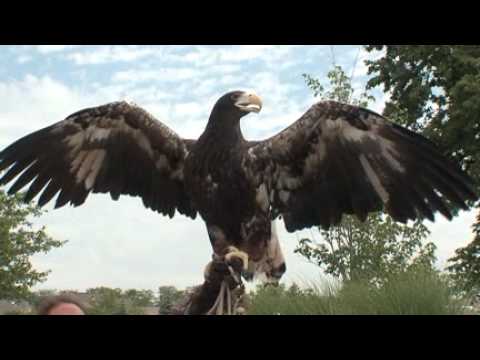
Three eagles of near-identical heft lead the field, ranked by the midpoint of each species’ published adult weight range, a measure that orders them differently from wingspan or length.
Pictured: a Steller’s sea eagle, from a Cincinnati Zoo video; it is #1 with a typical mass of 7.2 kg (range 4.9–9.5 kg).
Rank
Species
Typical mass (kg, midpoint)
Mass range (kg)
Wingspan (cm)
Length (cm)
IUCN status
Region
1
Steller’s Sea Eagle (Haliaeetus pelagicus)
7.2
4.9–9.5
195–250
85–105
Vulnerable
Asia
2
Harpy Eagle (Harpia harpyja)
6.5
4–9
176–224
86–107
Vulnerable
Americas
3
Philippine Eagle (Pithecophaga jefferyi)
6.35
4.7–8
184–220
86–102
Critically Endangered
Asia
4
White-tailed Eagle (Haliaeetus albicilla)
5
3.1–6.9
178–245
66–94
Least Concern
Europe & Asia
5
Verreaux’s Eagle (Aquila verreauxii)
5
3–7
181–230
75–96
Least Concern
Africa
6
Golden Eagle (Aquila chrysaetos)
4.75
2.8–6.7
185–220
66–102
Least Concern
Northern Hemisphere
7
Bald Eagle (Haliaeetus leucocephalus)
4.65
3–6.3
180–230
71–96
Least Concern
Americas
8
Martial Eagle (Polemaetus bellicosus)
4.35
2.2–6.5
188–240
78–96
Endangered
Africa
9
Wedge-tailed Eagle (Aquila audax)
3.9
2–5.8
182–232
81–106
Least Concern
Australasia
10
Crowned Eagle (Stephanoaetus coronatus)
3.63
2.55–4.7
151–181
80–99
Near Threatened
Africa
11
Steppe Eagle (Aquila nipalensis)
3.6
2.3–4.9
165–262
60–89
Endangered
Asia & Africa
12
Eastern Imperial Eagle (Aquila heliaca)
3.5
2.45–4.54
176–220
68–90
Vulnerable
Europe & Asia
13
Pallas’s Fish Eagle (Haliaeetus leucoryphus)
2.87
2.03–3.7
180–215
72–85
Endangered
Asia
No matching rows.
Ranking rule: every species is ordered by one number, the midpoint between the lightest and heaviest adult weights (both sexes) published on that species’ Wikipedia account, which itself draws on Raptors of the World (Ferguson-Lees & Christie), the CRC Handbook of Avian Body Masses and the Handbook of the Birds of the World; the full range is shown beside it, and Cornell’s All About Birds was used as a check for the bald and golden eagles. Wingspan and length use the same accounts, so they rank species differently: the white-tailed and Steller’s sea eagles, the martial eagle and the wedge-tailed eagle all have wingspans as long as the three heaviest, and the Philippine eagle is the longest eagle even though two others outweigh it. Ranges are wide because females run 10 to 35 percent heavier than males, so close rows are near-ties: Philippine and harpy (6.35 and 6.5 kg), white-tailed and Verreaux’s (both 5.0 kg, with the white-tailed ranked first because its reported mean weights are higher), golden and bald, and the crowned, steppe and eastern imperial eagles (3.5 to 3.63 kg). Sources disagree on several species, so a different handbook could shuffle neighbouring ranks. The steppe eagle’s wingspan is very variable (165 to 174 cm in the smallest birds, up to 262 cm in the largest). Included are the large “true” eagles, sea eagles and forest eagles of the family Accipitridae; vultures, condors, ospreys and the extinct Haast’s eagle are left out, as are the smaller hawk-eagles and snake eagles. IUCN categories are as shown in each species’ Wikipedia infobox and can change at the next Red List review.[1]
The Top 10
#1
Steller’s Sea Eagle — 7.2 kg
The heaviest eagle on most measures and the largest member of the sea eagle genus. Females weigh 6.2 to 9.5 kg and males 4.9 to 6.8 kg, so the pair midpoint here is 7.2 kg; mean weights reported for wild birds range from a median of 6.25 kg to a mean of 7.75 kg, and the figure drops sharply in lead-poisoned birds, which are left out. The wingspan is 1.95 to 2.5 m, and a Wikipedia summary of the standard measurements notes it can be matched or beaten on length by the harpy and Philippine eagles. It breeds in the Russian Far East, takes mostly salmon and trout, and is Vulnerable.[2]
#2
Harpy Eagle — 6.5 kg
The most powerfully built eagle of the Americas and the one with the biggest weight gap between the sexes. Females typically weigh 6 to 9 kg (some sources say up to 10 kg) and males 4 to 6 kg; reported averages are 4.4 to 4.8 kg for males and 7.3 to 8.3 kg for females, a difference of 35 percent or more. A captive female named Jezebel weighed 12.3 kg, an outlier that is not used in the ranking. It hunts monkeys and sloths in tropical forest canopy from Mexico to Argentina, and it is Vulnerable.[3]
#3
Philippine Eagle — 6.35 kg
Often called the largest eagle by length and wing area, though two other species outweigh it. The full adult weight range reported is 4.7 to 8 kg, while other researchers found averages nearer 4.5 kg, so this is the softest of the top three figures and it sits in a near-tie with the harpy eagle. Specimens average 95 cm long in males and 105 cm in females, and its tarsus is the longest of any eagle. It lives only in the Philippines, its forests are shrinking, and it is Critically Endangered.[4]
#4
White-tailed Eagle — 5 kg
The biggest eagle of Europe. Females typically weigh 4 to 6.9 kg and males 3.1 to 5.4 kg; reintroduced Scottish birds of Norwegian stock averaged 4.98 kg for 39 males and 6.06 kg for 43 females. The heaviest females can reach 7.5 to 8 kg. Its wingspan, 1.78 to 2.45 m, is among the longest of any living eagle, with records of 2.53 and 2.6 m. It is Least Concern.[5]
#5
Verreaux’s Eagle — 5 kg
Africa’s black eagle, a cliff specialist that mostly hunts rock hyraxes. Males weigh 3 to 4.2 kg and the larger females 3.1 to 7 kg, which puts the range midpoint level with the white-tailed eagle, but its mean weight, about 4.19 kg for 21 birds of both sexes, is lower, so the white-tailed eagle is ranked ahead on the tie. It is 75 to 96 cm long, making it the sixth longest eagle, and has a 1.81 to 2.3 m wingspan. Least Concern. No suitable verified video was found.[6]
#6
Golden Eagle — 4.75 kg
The most widespread large eagle in the Northern Hemisphere. Males weigh 2.8 to 4.6 kg (average 3.69) and females 3.8 to 6.7 kg (average 5.17); Cornell’s All About Birds gives 3.0 to 6.1 kg for both sexes, in close agreement. Regional forms differ, and one captive female of the Central Asian berkut form had an authenticated wingspan of 2.81 m. It is Least Concern.[7]
#7
Bald Eagle — 4.65 kg
North America’s sea eagle. Weights are normally 3 to 6.3 kg, with females about 25 percent larger than males (average up to 5.6 kg against 4.1 kg), and large Alaskan females can top 7 kg. Cornell gives the same 3 to 6.3 kg range. It builds the largest tree nests recorded for any animal, up to 4 m deep, and it is Least Concern.[8]
#8
Martial Eagle — 4.35 kg
Africa’s largest eagle, a savanna hunter. Males weigh 2.2 to 3.8 kg and females 4.45 to 6.5 kg, and unsexed birds from several studies averaged 3.93 to 4.23 kg. The wingspan is 1.88 to 2.4 m. It was reassessed as Endangered in the 2020 IUCN assessment cited by Wikipedia.[9]
#9
Wedge-tailed Eagle — 3.9 kg
Australia’s biggest bird of prey and the heaviest raptor on its continent. Females weigh 3 to 5.8 kg and males 2 to 4 kg; one guide lists mean masses of 2.5 and 4.7 kg, which would be one of the largest size gaps between sexes of any bird of prey. A maximum wingspan of 2.84 m and a length up to 1.06 m are reported, though typical spans are 1.82 to 2.32 m. Least Concern.[10]
#10
Crowned Eagle — 3.63 kg
The African forest counterpart of the harpy eagle: short wings, strong feet and a habit of taking monkeys. Females weigh 3.2 to 4.7 kg and males 2.55 to 4.12 kg. It is the fifth longest living eagle at 80 to 99 cm but its 1.51 to 1.81 m wingspan is far smaller than the martial eagle’s. Near Threatened.[11]
Wikipedia species accounts for all 13 species, read from the raw page text on 2026-10-17 (adult mass ranges, wingspan, length, IUCN infobox status), citing Ferguson-Lees & Christie, Raptors of the World; Dunning, CRC Handbook of Avian Body Masses; and del Hoyo et al., Handbook of the Birds of the World. Ranks 11–13 and the Philippine, steppe, eastern imperial and Pallas’s fish eagle rows rest on these accounts alone: Steppe eagle (males 2.5–3.5 kg, females 2.3–4.9 kg), Eastern imperial eagle (5 males 2.45–2.72 kg, 5 females 3.26–4.54 kg), Pallas’s fish eagle (females 2.1–3.7 kg, males 2.03–3.3 kg). IUCN Red List (iucnredlist.org) categories as quoted in the infoboxes; the Red List site itself was not opened for this post.
Wikipedia, “Steller’s sea eagle” (females 6.2–9.5 kg, males 4.9–6.8 kg, wingspan 1.95–2.5 m, length 85–105 cm); Guinness World Records, largest eagle (5–9 kg), as a cross-check.
Wikipedia, “Philippine eagle” (4.7–8.0 kg, wingspan 184–220 cm, length 86–102 cm, specimen averages 95 and 105 cm); National Geographic, “Watch an endangered eagle chick grow up in rare video” (about 400 pairs).
Wikipedia, “Verreaux’s eagle” (males 3–4.2 kg, females 3.1–7 kg, mean 4.19 kg for 21 birds, wingspan 1.81–2.3 m, length 75–96 cm).
Wikipedia, “Golden eagle” (males 2.8–4.6 kg, females 3.8–6.7 kg, length 66–102 cm); Cornell Lab of Ornithology, All About Birds, “Golden Eagle” (allaboutbirds.org: 3.0–6.1 kg, wingspan 185–220 cm, the source of this row’s wingspan).
Wikipedia, “Bald eagle” (3–6.3 kg, wingspan 1.8–2.3 m, female and male averages); Cornell Lab of Ornithology, All About Birds, “Bald Eagle” (allaboutbirds.org: 3.0–6.3 kg, length 71–96 cm, the source of this row’s length).