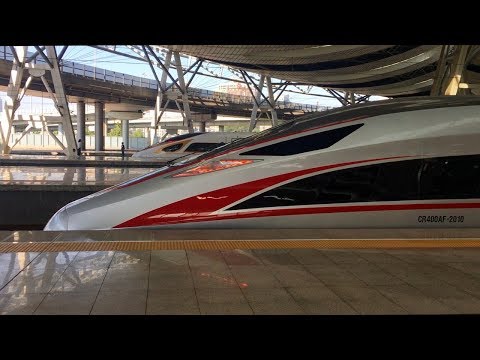
Passenger trains ranked by the top speed they actually run in regular service, as of October 11, 2026. China’s Fuxing and Indonesia’s Whoosh lead at 350 km/h, and the Shanghai Maglev no longer makes the top spot: it has run at 300 km/h since 2021.
Pictured: the “China Fuxing High Speed Bullet Train 350km/h!” video, for the CR400 Fuxing, tied #1 with a 350 km/h operating speed.
Rank
Train / service
Max operating speed (km/h)
(mph)
Country
Operator
Type
In service since
Record test speed (km/h)
1
CR400 Fuxing (Beijing–Shanghai and other lines)
350
217
China
China Railway
High-speed rail
2017
420
1
Whoosh (KCIC400AF, Jakarta–Bandung)
350
217
Indonesia
KCIC
High-speed rail
2023
385
3
Shinkansen E5/H5 Hayabusa (Tokyo–Shin-Aomori)
320
199
Japan
JR East / JR Hokkaido
High-speed rail
2011
—
3
TGV (LGV Est, Paris–Strasbourg)
320
199
France
SNCF Voyageurs
High-speed rail
2007
574.8
3
ICE 3 (on France’s LGV Est; 300 km/h in Germany)
320
199
Germany
Deutsche Bahn
High-speed rail
2000
368
3
Al Boraq (Tangier–Kenitra)
320
199
Morocco
ONCF
High-speed rail
2018
—
7
KTX-Sancheon (Gyeongbu line)
305
190
South Korea
Korail
High-speed rail
2010
—
8
Shanghai Maglev (Longyang Road–Pudong Airport)
300
186
China
Shanghai Maglev Transportation Development
Maglev
2004
501
8
AVE S-103 (Madrid–Barcelona)
300
186
Spain
Renfe
High-speed rail
2008
403.7
8
Frecciarossa 1000 (Rome–Milan)
300
186
Italy
Trenitalia
High-speed rail
2015
—
8
THSR 700T (Taipei–Kaohsiung)
300
186
Taiwan
Taiwan High Speed Rail
High-speed rail
2007
315
8
Haramain Talgo 350 (Mecca–Medina)
300
186
Saudi Arabia
Saudi Arabia Railways
High-speed rail
2018
310
13
Sapsan (Moscow–St Petersburg)
250
155
Russia
Russian Railways
High-speed rail
2009
290
13
YHT (Ankara–Istanbul)
250
155
Turkey
TCDD Taşımacılık
High-speed rail
2009
—
15
NextGen Acela / Avelia Liberty (Northeast Corridor)
241
150
United States
Amtrak
High-speed rail
2025
—
No matching rows.
As of October 11, 2026.Ranking rule: the maximum speed the service is allowed to run at in regular commercial passenger service on its fastest line, as stated by the operator or a reputable source, in km/h with miles per hour converted from it. Design speeds, certified top speeds and test runs are not ranked; where a train runs faster on one line than another, the fastest line counts (so the ICE 3 is listed at its 320 km/h on France’s LGV Est, not Germany’s 300). Ties share a rank, and “In service since” is the year the train or line opened, not the year its top speed was reached.[1]Test records (not ranked): the “Record test speed” column shows the fastest sourced test run for rows where we found one, and a dash means none was sourced. The overall rail record is Japan’s L0 Series maglev at 603 km/h (2015, a test line only); the conventional-rail record is the TGV V150 at 574.8 km/h (2007), and China’s CR450 has reached 453 km/h in testing.[14]Not yet in service: China’s CR450 is meant to run at 400 km/h but, as of today, we found no report that it has entered passenger service, so it is not ranked.[3]Trimmed: the table stops at 15 rows; Eurostar, Uzbekistan’s Afrosiyob (rated 250 km/h), Brightline and other slower services fall outside it. Caveats: some sources credit the Madrid–Barcelona AVE with 310 km/h and the Gyeongbu KTX-Cheongryong with 320 km/h, but the more conservative published figures are used here.
The Top 10
#1 (tie)
CR400 Fuxing — 350 km/h
China’s Fuxing (“Rejuvenation”) trains run at 350 km/h on the Beijing–Shanghai line, a speed restored on September 21, 2017 after the line had been slowed to 300 km/h in 2011.[2] They were designed for a 400 km/h limit and have reached 420 km/h in a coupling test, but 350 km/h is the speed passengers actually get.[2] The faster CR450 is meant to take over at 400 km/h, but it was still finishing testing and design approval in 2026 with no confirmed service date.[3]
#1 (tie)
Whoosh (Jakarta–Bandung) — 350 km/h
Southeast Asia’s first high-speed railway opened in October 2023 with a China-built train derived from the CR400AF, and its operator KCIC and Wikipedia both give an operating speed of 350 km/h.[4] The design speed is 420 km/h and a trial run reached 385 km/h.[4] The line is only about 143 km long, so trains spend little time at full speed.
#3 (tie)
Shinkansen E5/H5 Hayabusa — 320 km/h
The E5 entered service in March 2011 at 300 km/h and was raised to 320 km/h between Utsunomiya and Morioka on March 16, 2013.[5] The H5 version, which runs through to Hokkaido, has the same rating but is held to 260 km/h on the Hokkaido Shinkansen and 160 km/h through the Seikan Tunnel.[5] Japan’s Tokaido line, the busiest, runs slower.
#3 (tie)
TGV on LGV Est — 320 km/h
France’s eastern line from Paris toward Strasbourg opened on June 10, 2007 with 320 km/h commercial running, a first for the country, though the track was built to allow up to 350 km/h.[6] Weeks earlier, on April 3, 2007, a special V150 TGV set the conventional-rail world record of 574.8 km/h on that very line, a test run that is not part of the ranking.[6]
#3 (tie)
ICE 3 — 320 km/h in France, 300 km/h in Germany
Germany’s ICE 3 runs at a maximum of 300 km/h at home, for example on the Cologne–Frankfurt line, but is allowed 320 km/h on French lines such as the LGV Est, where it has run alongside TGVs since June 2007.[7] The class is certified for 330 km/h and reached 368 km/h on trial runs, neither of which counts here.[7] The video shows the 300 km/h German leg.
#3 (tie)
Al Boraq — 320 km/h
Africa’s first high-speed service opened on November 15, 2018 and is still the continent’s only one running at 320 km/h.[8] The speed applies only to the roughly 186 km high-speed line from Tangier to Kenitra; the Kenitra–Casablanca stretch is conventional track limited to 160 km/h.[8] A 430 km extension to Marrakech began construction in April 2025.[8]
#7
KTX-Sancheon — 305 km/h
South Korea’s home-built high-speed train is listed with a 305 km/h maximum operating speed on the Gyeongbu line, which is built for 350 km/h.[9] The newer KTX-Cheongryong, in service since May 2024, is rated for 320 km/h, but sources say infrastructure upgrades expected by 2028 are needed before it can run that fast, so 305 km/h is used here.[9]
#8 (tie)
Shanghai Maglev — 300 km/h
The world’s first commercial high-speed maglev links Longyang Road with Pudong Airport, about 30 km in roughly 8 minutes. It opened in 2004 and ran a famous 431 km/h peak until May 2021, when the cruising speed was cut to 300 km/h; travel guides say the 431 km/h schedule has not been restored.[10] That is why it no longer tops lists that still quote 431 km/h, and its 501 km/h record was set in a 2003 test.[10]
#8 (tie)
AVE S-103 on Madrid–Barcelona — 300 km/h
Spain’s Siemens Velaro-based S-103 is certified for 350 km/h and reached 403.7 km/h in a test, but it runs in service at 300 km/h on the Madrid–Barcelona line that opened in 2008.[11] Some references say the line was cleared for 310 km/h, a figure that conflicts with Wikipedia’s 300 km/h, so it is shown at the lower number.[11]
#8 (tie)
Frecciarossa 1000 — 300 km/h
Trenitalia’s flagship was designed for up to 400 km/h and a 360 km/h commercial target, but Italy’s infrastructure limits it to 300 km/h, which is also its certified service speed.[12] It began running between Milan and Rome in April 2015.[12]
Method and cross-checks: Wikipedia pages for each train and line, as surfaced by search summaries (the pages themselves could not be opened from our build environment); operating speeds follow the operator figure where one was found, otherwise a Wikipedia infobox.
Wikipedia, “Fuxing (train)”, “China Railway CR400AF” and “CR400BF” (350 km/h operating, 400 km/h design, 420 km/h record); UIC e-news, “China’s new high-speed train debuts on Beijing-Shanghai route” (July 2017); Xinhua/gov.cn (August 21, 2017) and Railway News on the restoration of 350 km/h from September 21, 2017.
Wikipedia, “China Railway CR450AF”; Railway Pro, “The world’s fastest conventional train is nearing launch in China”; China Daily HK, “China’s CR450 high-speed train moves a step closer to commercial operation” (March 2026: type tests and 300,000 km of assessment complete, design to be finalized in 2026, 453 km/h test peak). No report of passenger service was found as of October 11, 2026.
Wikipedia, “High-speed rail in Indonesia” and “China Railway CR400AF” (350 km/h service, 385 km/h trial, 420 km/h design); Gulf News/Reuters and NOW! Jakarta, “Whoosh: inside Indonesia’s first bullet train” (October 2023).
Wikipedia, “E5 and H5 Series Shinkansen”, “Hayabusa (train)” and “Tōhoku Shinkansen” (320 km/h from March 16, 2013; H5 limits on the Hokkaido line); JR East press release archive.
Wikipedia, “LGV Est” (320 km/h commercial service from June 10, 2007); Alstom, “574,8 km/h: new world rail speed record set at 13h13 on 3 April 2007” and Wikipedia, “TGV POS” (V150 record).
Wikipedia, “ICE 3” (300 km/h in Germany, 320 km/h on French lines, 330 km/h certified for Cologne–Frankfurt, 368 km/h trial); Märklin product page and Railmarket on ICE 3 service on LGV Est.
Wikipedia, “Al Boraq”; International Travel News, “Africa’s first high-speed train”; Hespress and Morocco World News (2025–2026) on the 320 km/h service and the Marrakech extension.
Wikipedia, “KTX-Sancheon”, “KTX” and “KTX-Cheongryong” (305 km/h service maximum); Railway Technology and Alcircle (May 2024 launch; 320 km/h potential by 2028); Hyundai Rotem EMU-320 coverage, Railway News (InnoTrans 2026).
Wikipedia, “Shanghai maglev train” and Structurae (300 km/h operating speed after May 2021, 431 km/h before; 501 km/h test, November 12, 2003); Wanderinchina, “Shanghai Maglev Train Guide 2026” and Andy B Travels (300 km/h all day). These are mostly travel sites; we could not reach the operator directly, and some other sites still print 431 km/h.
Wikipedia, “Renfe Class 103”, “AVE” and “Madrid–Barcelona high-speed rail line” (300 km/h, 310 km/h in 2011–2016 per one infobox; Railway Gazette, “Madrid–Barcelona at 310 km/h with ETCS Level 2”); Seat61, “A Renfe AVE train from Madrid to Barcelona”.
Wikipedia, “Frecciarossa 1000”; FS Italiane, “Frecciarossa 1000” and 2015 press releases (certified 300 km/h); Railway Technology, “Frecciarossa 1000 very high speed train” (first Milan–Rome journey April 25, 2015).
Rows 8–15 not written up above: Wikipedia, “THSR 700T” and “Taiwan High Speed Rail” (300 km/h service, 315 km/h test); Wikipedia, “Haramain High Speed Railway”, MEED and Global Railway Review (300 km/h, 310 km/h test, 2018 opening); Wikipedia, “Sapsan” (250 km/h, December 2009, 290 km/h record) and UIC e-news (November 2009); Wikipedia, “High-speed rail in Turkey”, Seat61 and Railway Technology (YHT at 250 km/h on Ankara–Istanbul; 2009 opening is from general knowledge and was not separately checked); Wikipedia, “Avelia Liberty” and Railway News (NextGen Acela service from August 28, 2025; rated 257 km/h, limited to 241 km/h by track). Opening years for KTX-Sancheon (2010), AVE S-103 (2008) and the Shanghai Maglev (2004) are from the same pages or general knowledge.
Wikipedia, “Chūō Shinkansen” and Nippon.com (L0 Series 603 km/h on April 21, 2015; Tokyo–Nagoya opening no earlier than about 2034–2036); Alstom (TGV record); Railway Pro (CR450 453 km/h).
Video embeds were matched to their trains by title in a YouTube-restricted search; the uploader channel could not be confirmed for most of them and several are not operator videos (the Shanghai Maglev clip is a third-party ride video). KTX-Sancheon keeps the icon because the clips found did not identify that model.