Average annual net forest loss over 2010–2020, from the UN Food and Agriculture Organization’s Global Forest Resources Assessment 2020. DR Congo lost about 1.1 million hectares a year, twice as much as Angola, and the top four countries account for more than half of Africa’s net loss.
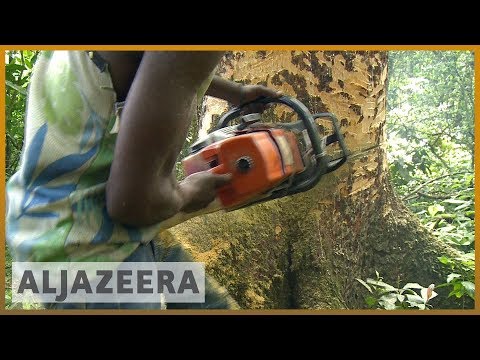
Pictured: an Al Jazeera report on logging in DR Congo’s rainforest, #1 with about 1.1 million hectares lost a year.
Rank
Country
Net loss per year (ha)
Annual rate
Forest area, 2020
Region
1
DR Congo
1,101,400
−0.83%
126.2M ha
Central Africa
2
Angola
555,100
−0.80%
66.6M ha
Central Africa
3
Tanzania
420,500
−0.88%
45.7M ha
East Africa
4
Mozambique
222,800
−0.59%
36.7M ha
East Africa
5
Zambia
188,200
−0.41%
44.8M ha
East Africa
6
Sudan
172,200
−0.89%
18.4M ha
North Africa
7
Nigeria
163,300
−0.73%
21.6M ha
West Africa
8
Chad
121,700
−2.45%
4.3M ha
Central Africa
9
Botswana
118,300
−0.74%
15.3M ha
Southern Africa
10
Côte d’Ivoire
112,900
−3.29%
2.8M ha
West Africa
11
Somalia
76,800
−1.20%
6.0M ha
East Africa
12
Ethiopia
73,000
−0.42%
17.1M ha
East Africa
13
Namibia
71,000
−1.01%
6.6M ha
Southern Africa
14
Cameroon
56,000
−0.27%
20.3M ha
Central Africa
No matching rows.
Source and scope: this updates RList’s original 2016 ranking of Africa’s loss of forested area by country. Every figure comes from FAO’s Global Forest Resources Assessment 2020 (FRA 2020), the most recent edition with figures published for every African country, as carried in the World Bank’s forest-area series.[1] “Net loss” is the change in forest area from 2010 to 2020 divided by ten: forest cleared minus forest that regrew or was planted, so it is smaller than gross deforestation. The annual rate is the compound yearly change over the same decade, and forest area is for 2020. FAO counts land with trees taller than 5 metres covering more than 10% of the ground, so open savanna woodland counts and tree crops such as cocoa do not. Regions follow the UN geoscheme. The list stops at 14 because Burkina Faso and Benin tie for 15th at about 50,000 ha a year. Newer data: FAO’s FRA 2025 (October 2025) puts Africa’s net loss at 2.96 million ha a year for 2015–2025, down from about 3.9 million in 2010–2020, and revises the order at the top: Angola (510,000 ha a year), Tanzania (469,000), DR Congo (283,000) and Mozambique (267,000). Its country-by-country figures for the rest of Africa were not available for this ranking.[2][3] See also the most forested countries in Africa.
The Top 10
#1
DR Congo — 1,101,400 ha a year
FRA 2020 put DR Congo’s net forest loss at about 1.1 million hectares a year for 2010–2020, the most in Africa and second in the world after Brazil.[1][3] It still had 126.2 million hectares of forest in 2020, about 56% of its land and most of the Congo Basin rainforest, down from 150.6 million in 1990.[1] Satellite studies find that most of the clearing is small-scale, by farmers opening new fields, rather than industrial logging or plantations.[5] FRA 2025 revises the figure sharply, to about 283,000 ha a year of net loss for 2015–2025, which would drop it to third in Africa. Satellite monitoring tells a different story: Global Forest Watch recorded a record 590,000 hectares of primary forest lost in DR Congo in 2024.[2][4]
#2
Angola — 555,100 ha a year
Angola lost an average of about 555,000 hectares of forest a year over 2010–2020, fourth in the world in FRA 2020.[1][3] Forest covered 63.6% of its land in 1990 and 53.4% in 2020, and the loss sped up after 2000.[1] Much of this forest is the dry Zambezian woodland of the south and east, which a 2025 satellite study found shrinking by about 0.83% a year on Angola’s side of the Zambezi basin.[6] In FRA 2025 Angola is Africa’s largest net forest loser, at about 510,000 ha a year for 2015–2025, second in the world after Brazil.[2]
#3
Tanzania — 420,500 ha a year
Tanzania ranked fifth in the world for net forest loss in FRA 2020, at about 421,000 hectares a year.[1][3] The pace rose during the decade, to about 469,000 ha a year in 2015–2020, and FRA 2025 gives the same 469,000 ha a year for 2015–2025, third in the world.[1][2] Its forest fell from 57.4 million hectares in 1990 to 45.7 million in 2020.[1] A 2025 satellite study of the Zambezi basin measured woodland loss of about 1.06% a year on Tanzania’s side, among the highest rates in that region.[6]
#4
Mozambique — 222,800 ha a year
Mozambique was tenth in the world for net forest loss in FRA 2020, at about 223,000 hectares a year.[1][3] Its forest shrank from 43.4 million hectares in 1990 to 36.7 million in 2020, falling from 55% to 47% of its land.[1] FRA 2025 puts its loss even higher, at about 267,000 ha a year for 2015–2025, sixth in the world.[2] FAO links Africa’s losses mainly to the spread of farming and to commercial logging, much of it illegal or poorly regulated.[2]
#5
Zambia — 188,200 ha a year
Zambia’s FRA 2020 country report shows net loss of only about 36,000 hectares a year in the 1990s and 2000s, rising more than fivefold to about 188,000 a year after 2010.[7] Even so, Zambia remains one of Africa’s most wooded countries, with 44.8 million hectares of forest, about 60% of its land, in 2020.[1] Satellite mapping of the Zambezi basin finds Zambia’s woodland shrinking by about 0.93% a year.[6]
#6
Sudan — 172,200 ha a year
Sudan lost about 172,000 hectares of forest a year over 2010–2020, and its forest area fell from 21.8 million hectares in 2000 to 18.4 million in 2020.[1] Forest covers less than 10% of the country, so the same losses take a larger share of what is left than in the heavily forested countries above it; its 0.89% annual rate is the highest of the top six.[1] The figures are for present-day Sudan; South Sudan, independent since 2011, is counted separately.[1]
#7
Nigeria — 163,300 ha a year
Nigeria lost about 163,000 hectares of forest a year in FRA 2020, a steady rate since 1990 that took its forest from 26.5 million hectares to 21.6 million.[1][8] The often-quoted claim that Nigeria loses about 400,000 hectares a year is close to FAO’s earlier FRA 2015 estimate of roughly 410,000 ha a year. FAO says the FRA 2020 report used new and better data and found much more forest than before, so the two editions should not be compared.[8]
#8
Chad — 121,700 ha a year
Chad has little forest to lose: just 4.3 million hectares in 2020, about 3.4% of its land.[1] At 2.45% a year it was losing that forest faster than any other country in the top ten except Côte d’Ivoire, and the decline sped up after 2000. It had 6.7 million hectares in 1990, so roughly a third of its forest has gone since then.[1]
#9
Botswana — 118,300 ha a year
Botswana’s 15.3 million hectares of forest covered about 27% of its land in 2020.[1] Its FAO figures show the same loss, about 118,000 hectares a year, in every decade since 1990, taking it from 18.8 million hectares to 15.3 million. A perfectly constant rate usually means the figure is projected from a few surveys rather than measured each year, so it is less certain than the others.[1]
#10
Côte d’Ivoire — 112,900 ha a year
Côte d’Ivoire has the fastest rate of forest loss in this ranking, at 3.29% a year. Its forest fell from 7.85 million hectares in 1990 to 2.84 million in 2020, and now covers less than 9% of the country.[1] The expansion of cocoa farms, which supply much of the world’s chocolate, is the main driver.[9] FAO does not count cocoa grown under shade trees as forest, so land that still looks wooded can be counted as lost.[1] The country’s own national forest inventory gives a similar 2020 total of about 2.97 million hectares. Chatham House estimates that Côte d’Ivoire lost about 80% of its forests between 1900 and 2021.[9][10]
FAO, Global Forest Resources Assessment 2020 (FRA 2020): forest area by country for 1990, 2000, 2010, 2015 and 2020, as carried in the World Bank’s World Development Indicators, “Forest area (sq. km)” (AG.LND.FRST.K2) and “Forest area (% of land area)” (AG.LND.FRST.ZS), September 2021 release. RList calculated each country’s 2010–2020 average annual net change and compound annual rate from these areas; fao.org/forest-resources-assessment.
FAO, Global Forest Resources Assessment 2025 (October 2025), key findings and “Forest extent and change” chapter, including its top ten countries for annual net loss of forest area, 2015–2025, and DR Congo’s primary forest trend; country figures as reproduced by Visual Capitalist, “Ranked: Countries With the Highest Rates of Forest Loss”, and Ecofin Agency, “Africa Loses Nearly 30 Million Hectares of Forest in a Decade, FAO Says” (2025).
UN News, “Deforestation has slowed down but still remains a concern, new UN report reveals” (July 2020), the FRA 2020 top ten for net loss; The EastAfrican, “Africa’s forest cover drops despite greater efforts to save trees”, citing FRA 2020’s figure of about 3.9 million ha a year of net loss in Africa for 2010–2020.
Mongabay, “DRC hit by record deforestation in 2024, satellite data show” (November 2025), reporting Global Forest Watch / University of Maryland tree-cover-loss data.
Tyukavina, A. et al., “Congo Basin forest loss dominated by increasing smallholder clearing”, Science Advances (2018).
“Deforestation in the Zambezi ecoregion, 2000–2023” (satellite study), Frontiers in Remote Sensing (2025), doi:10.3389/frsen.2025.1590591.
FAO, “Global Forest Resources Assessment (FRA) 2020: Zambia” country report.
FAO, “Global Forest Resources Assessment (FRA) 2020: Nigeria” country report, and “Global Forest Resources Assessment 2015: Nigeria” country report; The Guardian (Nigeria), “Nigeria loses 400,000 hectares of forest yearly”.
Timber Trade Portal, “Republic of Côte d’Ivoire: country context”, and Mongabay (via Save the Elephants), “Côte d’Ivoire braces to save what’s left of its single-digit forest cover”, on cocoa-driven clearing and the national forest and wildlife inventory.
Chatham House, “Deforestation in Africa” (May 2023).